
Trusted by leading companies
Temperature controlled logistics
Cold chain systems designed for storage, handling and transport across real distribution networks
— Built for Consistency, Compliance and Cold Chain Control —
Managing temperature across more than just the journey
Temperature controlled logistics is the process of storing, handling and transporting goods within defined temperature ranges across the full distribution chain. In practice, that means maintaining temperature control not only while a shipment is in transit, but also during staging, loading, handovers, storage and final delivery. Hydropac’s current logistics proposition already reflects this broader view, describing temperature controlled logistics as the management of goods that must remain within specific temperature limits, including food, pharmaceutical and other temperature-sensitive products.
This is what makes logistics different from shipping alone. A shipment may spend only part of its total journey in a vehicle, while the rest of its exposure is shaped by operational delays, warehouse handling and multiple transfer points. Hydropac supports temperature controlled logistics by aligning passive packaging systems, refrigerants and performance requirements to the way goods actually move through real networks, helping businesses maintain product integrity without relying on idealised transport assumptions. Hydropac’s wider packaging content also emphasises that insulation, coolant behaviour and pack-out configuration must work together under real logistics conditions.
Discover Temperature controlled logistics
Hydropac isn’t just packaging; it’s a revolution of quality, innovation, and sustainability. Join us on this exciting journey to redefine packaging excellence.


Temperature controlled logistics fails at handovers, not just in transit
Temperature control is often discussed as a transport issue, but in practice many cold chain failures begin outside the vehicle. Risk builds during order assembly, staging, loading, transfer between facilities and final delivery, particularly where shipments move through multiple environments before reaching the end user. These handover points create cumulative exposure that packaging systems must be able to absorb. Hydropac’s 24–72 hour packaging guidance reflects this reality, explaining that real parcel journeys involve multiple thermal exposures rather than one stable transport event.
This is why temperature controlled logistics must be designed around the full network, not only the planned transit window. A system that works in a controlled single-leg shipment may underperform in a multi-stage lane with variable dwell times, mixed handling conditions and inconsistent dispatch processes. The strongest logistics approach is one where packaging, refrigerants and operating practice are aligned to how the cold chain actually functions day to day.

What temperature controlled logistics includes
Temperature controlled logistics covers the full movement of temperature-sensitive goods through storage, handling and transport, all within a defined thermal framework. It is not limited to linehaul or final-mile delivery. It also includes pre-dispatch staging, loading, temporary storage, cross-docking, depot handling and the final handover to the customer.
For products such as chilled food, pharmaceuticals and other temperature-sensitive materials, this means that performance must be maintained across multiple stages rather than a single transport event. Hydropac’s current logistics page already defines the discipline in these broader terms, covering storing, transporting and handling within specific temperature ranges.
At a wider level, effective temperature controlled packaging supports logistics by providing one of the few consistent control points across the journey, even when route conditions and handling stages vary.
Where logistics risk builds across the cold chain
Cold chain risk rarely comes from one single moment. More often, it accumulates across the route as goods move through different environments and handover points.
The most common risk points include:
- pre-dispatch staging before collection
- transfer from warehouse to vehicle
- depot dwell time and route re-sorting
- ambient exposure during final-mile delivery
- failed deliveries or longer-than-planned lanes
- inconsistent pack-out across sites or shifts
This is exactly why route assumptions can be misleading. Hydropac’s 24–72 hour lane guidance explains that shipments are often exposed to repeated periods of ambient stress across sorting hubs, linehaul stages and delivery operations, rather than moving through one uninterrupted cold environment.
Where these risks are higher, shipping conditions become a key part of logistics planning, not just a transport detail.
Why packaging must match the logistics model
A packaging system should not be selected in isolation from the logistics model it is expected to support. A format that performs well in a tightly managed next-day lane may not be suitable for a network with longer durations, multiple handovers or greater operational variability.
In practice, the packaging choice should reflect factors such as:
- required temperature range
- expected duration, including delay margin
- number of handling stages
- likely ambient exposure
- repeatability of pack-out across operations
This is where Hydropac should be positioned strongly. Rather than treating packaging as a standalone product decision, the better approach is to align insulation, refrigerants and pack configuration to the actual lane structure. Hydropac’s broader shipping content already supports this by stating that effective performance depends on how systems are packed, handled and exposed in real distribution conditions.
For narrower tolerances, this also connects directly with temperature sensitive shipping. Where logistics risk is higher and more physical protection is needed, it also links naturally to temperature controlled courier boxes.
Monitoring, validation and route profiling
Reliable temperature controlled logistics depends on measured understanding, not assumption alone. WHO guidance on transport route profiling states that representative temperature data from actual supply-chain routes is needed to understand the transport environment and assess how a container or packaging system will perform over that route.
For higher-risk cold chains, that means reviewing:
- route and seasonal temperature exposure
- handling and storage conditions between transport legs
- expected versus actual transit duration
- repeatability of pack-out and dispatch processes
- whether the selected system is suitable for the defined range
This risk-based approach is also reflected in EU GDP guidance, which says that for temperature-sensitive products, qualified equipment such as thermal packaging, temperature-controlled containers or vehicles should be used to maintain correct transport conditions. The same guidance also requires appropriate temperature-monitoring equipment used during transport to be maintained and calibrated at regular intervals, at least once a year.
For deeper operational context, this connects well with the practical guide to temperature controlled packaging for 24–72 hour lanes.
Building repeatable cold chain performance
Strong temperature controlled logistics is not achieved by packaging alone. It comes from repeatable systems, where packaging, refrigerants and operating procedures are aligned to the same cold chain requirement.
In practice, that usually means:
- standardised pack-out procedures
- consistent refrigerant conditioning
- clear staging and dispatch controls
- packaging selected against real route conditions
- sufficient performance margin for delays and variability
This is where Hydropac can look most professional. The company’s wider content consistently points toward a system-based approach, combining insulation and coolant solutions to perform under real logistics conditions rather than idealised scenarios.
The goal is not simply to ship cold products once, but to build a logistics model that can repeat the same temperature outcome across different days, routes and operating teams. For broader network planning, this also ties naturally into temperature controlled transport and the wider Hydropac cold chain proposition.
Contact us directly
We are ready to answer all your questions and help you find the perfect solution for your cold chain transport.
From issue to a customised cooling solution
In this way we help you to guarantee the quality and safety of food products under all circumstances.
Mass production
Transport
End user
FAQ's about Temperature controlled logistics
What is temperature controlled logistics?
Temperature controlled logistics is the management of storage, handling and transport for goods that must remain within a defined temperature range throughout distribution. It covers more than vehicle movement alone and includes staging, transfer points, storage and final delivery. Hydropac’s own logistics page defines it in these broader operational terms.
How is temperature controlled logistics different from temperature controlled shipping?
Temperature controlled shipping focuses more directly on what happens to a shipment in transit. Temperature controlled logistics is broader and includes the full process around storage, handling, handovers, route structure and operational consistency across the cold chain.
Why do handovers matter in cold chain logistics?
Handovers often introduce additional ambient exposure, delays and handling variation. These stages can reduce the effective performance window of a packaging system and increase the likelihood of temperature deviation, especially when multiple logistics points are involved. Hydropac’s own 24–72 hour lane guidance reflects this repeated-exposure reality.
How do I know if my logistics model needs a more robust packaging system?
If routes regularly exceed planned durations, pass through multiple handling stages, include failed deliveries or expose shipments to greater ambient variation, your current system may not provide enough performance margin. In those cases, packaging should be reviewed against the actual logistics model rather than the nominal shipping window alone.
Does temperature controlled logistics require monitoring and validation?
For many temperature-sensitive applications, yes. WHO route profiling guidance and EU GDP guidance both support a measured, risk-based approach to understanding route exposure and ensuring the chosen transport system is suitable for the product and distribution conditions.
— Related articles —
 Temperature controlled packaging
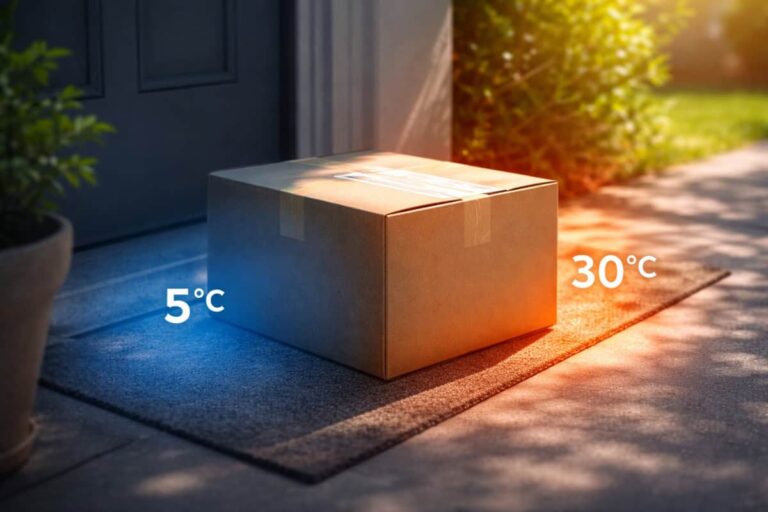
 Seasonal Pack-Outs: Summer and Winter Shipping
 Temperature controlled packaging
 A practical guide to temperature controlled packaging for 24–72 hour lanes
 Temperature controlled packaging