
Trusted by leading companies
Temperature controlled courier boxes
Rigid insulated shipping systems built for longer transit times, higher-risk routes and greater thermal stability
— Built for Performance, Protection and Operational Reliability —
When standard parcel formats no longer provide enough protection
Temperature controlled courier boxes are used where shipments need more than basic thermal protection. As transit duration increases and courier networks become less predictable, packaging must do more than simply slow heat ingress. It must provide stronger insulation, better physical protection and enough performance margin to absorb delays, handling exposure and last-mile variability.
This is where boxed systems become a better fit than lighter liner-based formats. By combining a rigid outer structure, internal insulation and the right refrigerant strategy, temperature controlled courier boxes can support stable internal conditions across chilled, frozen and temperature-sensitive applications. Hydropac develops these systems around real route profiles, product requirements and operational handling, helping businesses protect product quality without relying on generic duration claims alone.
Discover Temperature controlled courier boxes
Hydropac isn’t just packaging; it’s a revolution of quality, innovation, and sustainability. Join us on this exciting journey to redefine packaging excellence.
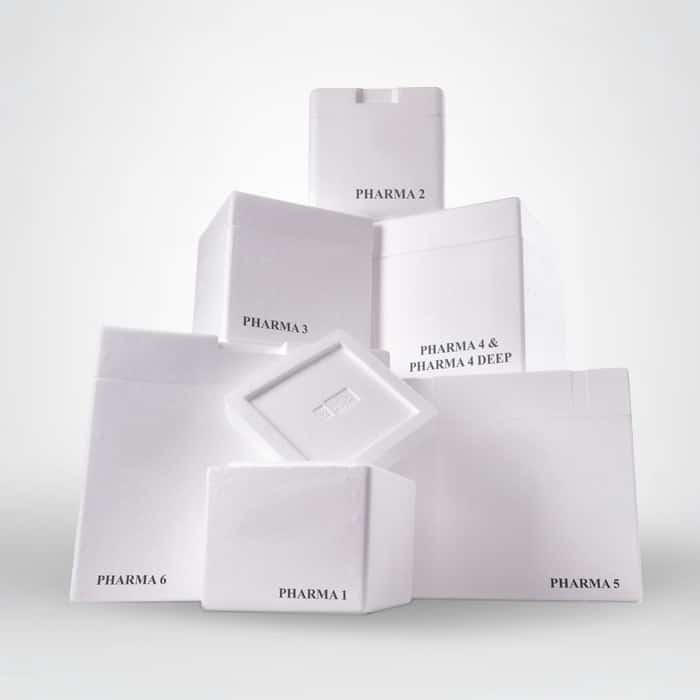
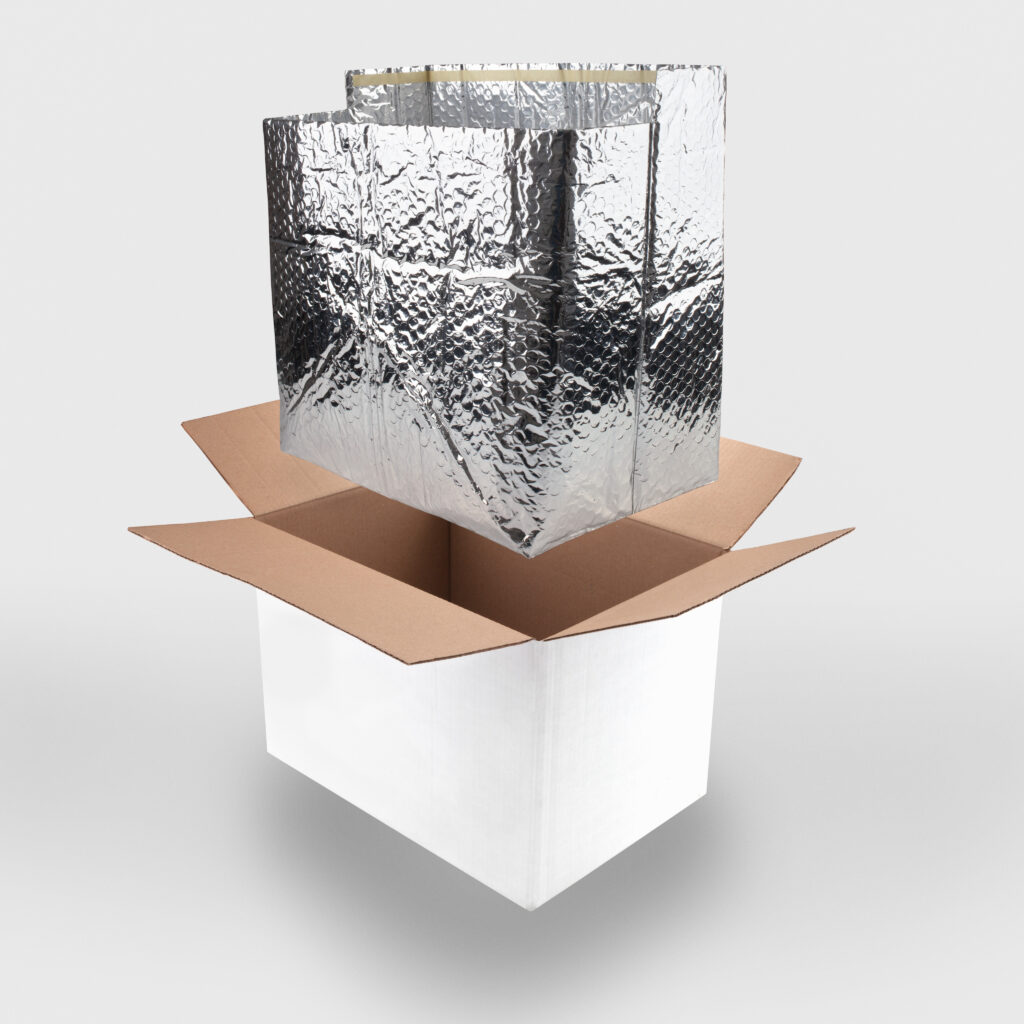
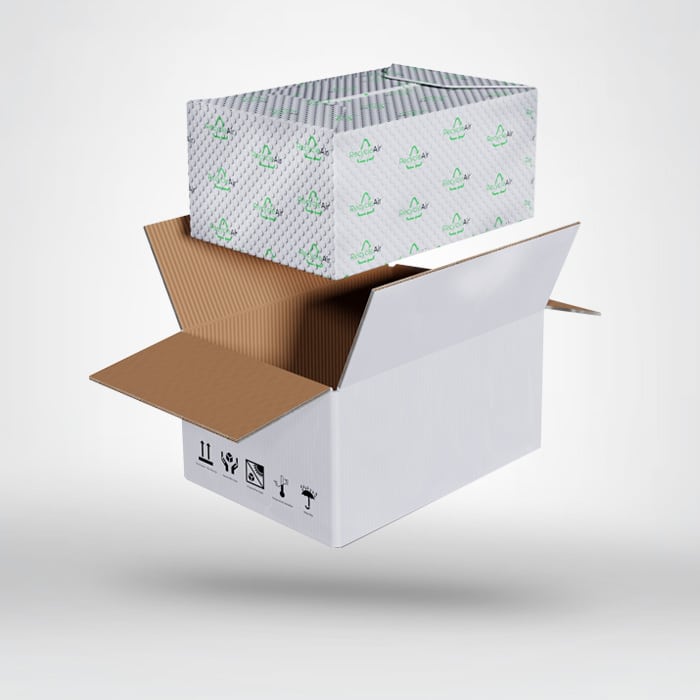

Courier boxes are designed for more than insulation alone
Temperature controlled courier boxes are not simply standard boxes with coolant added. They are configured shipping systems designed to combine thermal protection with structural reliability throughout the distribution cycle. That matters when shipments are exposed to repeated handling, variable ambient conditions and longer or less predictable delivery windows.
Compared with lighter liner-based formats, boxed systems can offer a stronger performance margin where route risk is higher. In practice, that may mean better resistance to heat ingress, more stable pack geometry and improved protection for products moving through courier and parcel networks. Hydropac’s existing proposition already reflects this, positioning courier boxes as purpose-built systems for extended protection, including chilled, frozen and pharmaceutical applications, with formats that can support up to 96-hour performance depending on configuration.
For shipments where stability, protection and repeatability matter more than minimum pack weight, courier boxes often become the more appropriate passive cold chain format.

What is a temperature controlled courier box?
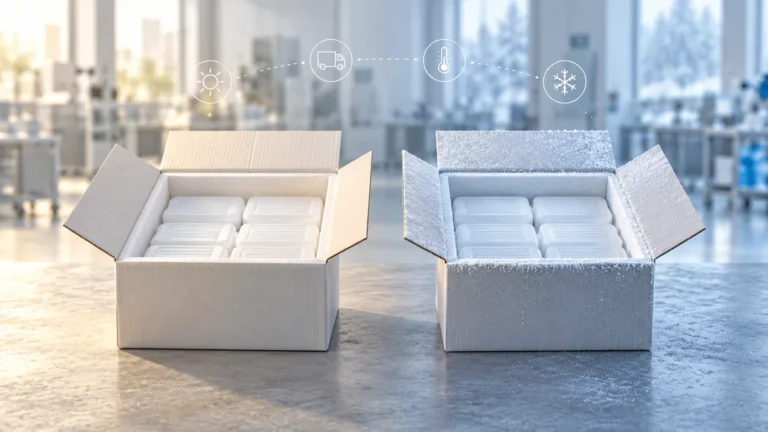
A temperature controlled courier box is a rigid or reinforced shipping format designed to maintain a defined internal temperature during distribution. Rather than relying on a single material, the system typically combines an outer box, an insulated inner format and refrigerants that work together to slow heat ingress and support controlled thermal performance.
Depending on the application, these systems may be used for chilled, frozen or more tightly controlled temperature-sensitive shipments. Hydropac’s current range already reflects this breadth, with EPS and pharmaceutical box formats positioned for food, pharma and biomedical use, and selected systems described as capable of supporting 2–8°C, frozen lanes and longer transit durations.
For businesses reviewing a wider temperature controlled packaging strategy, courier boxes sit at the point where added insulation, structure and system control become more important than the lightest possible parcel format.
When liner-based systems reach their limit
Flexible liners remain highly effective for many chilled parcel applications, particularly where durations are shorter and route conditions are relatively controlled. But as transit windows extend and exposure becomes less predictable, liner-based systems begin to reach their practical limits.
This typically happens when shipments face one or more of the following:
- delivery windows beyond standard next-day or short-duration parcel profiles
- increased depot dwell time or failed delivery risk
- tighter temperature tolerances
- higher-value or more sensitive products
- more intensive handling across courier networks
Hydropac already makes this distinction in its existing shipping content, noting that as transit duration and exposure risk increase, rigid insulated packaging and multi-layer courier systems are required to provide additional thermal stability. That makes shipping conditions a key factor in deciding when a courier box is more suitable than a liner-only format.
What courier boxes add over lighter parcel formats
The advantage of a courier box is not just that it uses more insulation. The real benefit is that it creates a more robust overall shipping system when variability increases.
In practice, courier boxes can offer:
- greater thermal resistance for extended or less predictable routes
- more physical protection during courier handling
- more consistent pack-out geometry and repeatability
- better compatibility with gel packs or PCM-based refrigerants
- a higher performance margin where delays are possible
This is why boxed systems are commonly used where routes exceed the comfort zone of standard parcel packaging, or where the consequence of deviation is higher. Hydropac’s EPS box proposition supports this directly, describing polystyrene as a highly efficient insulating material with extremely low thermal conductivity, while its pharmaceutical box range highlights extra thick insulated walls for both thermal protection and physical strength.
For products with a narrower tolerance to deviation, this added margin also links naturally with temperature sensitive shipping requirements.
Selecting the right courier box system
The right courier box system depends on route duration, product sensitivity, handling intensity and the level of performance margin required. The strongest solution is not always the heaviest one. The objective is to match the box format, insulation level and coolant strategy to the actual shipping risk.
Boxed systems for chilled parcel distribution
For chilled products moving through parcel networks, insulated box systems can provide a stronger alternative where standard liners no longer offer enough confidence. This is particularly relevant when routes extend beyond 24 hours, when ambient exposure is elevated, or when there is a higher likelihood of delay.
Higher protection for frozen and extended-duration shipping
For frozen goods or longer-duration lanes, courier boxes can support more stable performance by combining rigid insulation with correctly specified refrigerants. Hydropac’s current courier and pharma box content already points to systems used across 1-day to 5-day requirements and to configurations capable of maintaining controlled temperatures for up to 96 hours, depending on format and payload.
Refrigerants as part of the box system
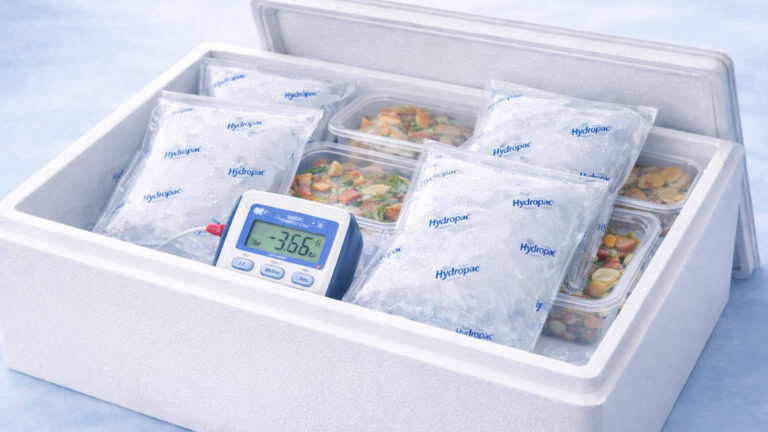
A courier box performs as a system, not as a shell. Refrigerant type, quantity, placement and conditioning all influence the internal temperature profile. Hydropac’s broader product mix, including gel packs and pharma-oriented insulated boxes, reinforces that effective performance depends on the interaction between insulation and coolant, not either one in isolation.
When validated or qualified systems are needed
Where products are more sensitive, tolerances are tighter or compliance expectations are higher, generic packaging claims may not be enough. EU GDP guidance states that for temperature-sensitive products, qualified equipment such as thermal packaging should be used to maintain correct transport conditions. This makes validated or qualified box systems particularly relevant for pharmaceutical and other higher-risk applications.
Performance, validation and operational suitability
Courier boxes should be selected on proven suitability, not on headline claims alone. A box format that looks robust on paper still needs to be aligned to actual transit time, payload, ambient exposure and handling conditions.
For that reason, assessment should focus on questions such as:
- What temperature range must be maintained?
- What is the expected transit duration, including delay margin?
- How much ambient exposure occurs during staging and delivery?
- How repeatable is the pack-out process across operations?
- Does the route justify a higher-performance insulated format?
Hydropac’s existing courier-box proposition already leans into this more professional framing, combining performance messaging with practical features such as custom sizes, branded outers and no tooling fees for custom-sized branded courier boxes. On the EPS side, the offer also includes food-safe, watertight and leakproof formats manufactured in the UK.
The most effective approach is to treat courier boxes as part of a wider cold chain system, where packaging, refrigerants and operating practice are aligned to the real distribution environment. For more route-based planning, this also connects naturally with a practical guide to temperature controlled packaging for 24–72 hour lanes and, at a broader level, with temperature controlled logistics.
Contact us directly
We are ready to answer all your questions and help you find the perfect solution for your cold chain transport.
From issue to a customised cooling solution
In this way we help you to guarantee the quality and safety of food products under all circumstances.
Mass production
Transport
End user
FAQ's about Temperature controlled courier boxes
What is the main advantage of using temperature controlled courier boxes over standard packaging?
The main advantage is that courier boxes are designed as insulated shipping systems rather than standard cartons. They provide greater thermal protection, stronger physical support and more stability across variable courier conditions, helping to protect chilled, frozen and temperature-sensitive products during transit. This aligns with Hydropac’s own positioning of courier boxes as purpose-built formats for consistent internal temperature control over extended periods.
When should I choose a courier box instead of a liner-based system?
A courier box becomes the better choice when transit durations are longer, handling conditions are less predictable, temperature tolerances are tighter or the consequence of deviation is higher. In these situations, boxed systems usually provide more thermal stability and a greater performance margin than lighter parcel formats.
Can temperature controlled courier boxes be used for both chilled and frozen shipping?
Yes. Depending on the insulation format and refrigerant configuration, courier boxes can be used for chilled and frozen shipping. Hydropac’s current range already positions insulated box formats for both chilled and frozen applications, including food and pharmaceutical uses.
Do courier boxes help with pharmaceutical or GDP-sensitive shipments?
They can, provided the system is correctly specified and, where needed, validated or qualified for the application. EU GDP guidance specifically refers to the use of qualified thermal packaging for temperature-sensitive medicinal products, which is why courier box systems are often relevant in pharmaceutical cold chains.
How long can a temperature controlled courier box maintain temperature?
That depends on the insulation format, payload, refrigerant strategy and external conditions. Hydropac’s existing courier-box content refers to performance of up to 96 hours in certain configurations, while parts of the pharma box range are positioned for 1-day to 5-day shipping requirements. Performance should always be assessed against the real route profile rather than assumed from duration claims alone.
— Related articles —
 Temperature controlled packaging
 Preventing temperature excursions in chilled distribution
 Temperature controlled packaging
 Seasonal Pack-Outs: Summer and Winter Shipping
 Temperature controlled packaging