
Seasonal Pack-Outs: Summer and Winter Shipping
Most pack-outs are validated once. Whichever season the project happened to run in becomes the reference condition, and the specification is then shipped year round on the quiet assumption that packaging is the variable and weather is background noise.
It is the other way round. In England the mean daily maximum moves from around 6 degrees C in January to around 23 degrees C in July. Against a payload held at 5 degrees C, that is the difference between almost no driving temperature gradient at all and a gradient of roughly 18 degrees. Heat ingress scales with that gradient, so the same box with the same coolant is working very much harder on an average July day than on an average January one.
A specification that survives both is either heavily over-engineered for nine months of the year or quietly under-engineered for three. In our assessment work it is usually the first, which is expensive, and occasionally the second, which is worse. And in UK conditions there is a third possibility that almost nobody tests for, which is that the winter configuration is freezing the product it was meant to protect.
What follows is what a parcel actually experiences across a UK year, and then how to run two configurations without turning the packing bench into a decision point.
Custom chilled solutions for you
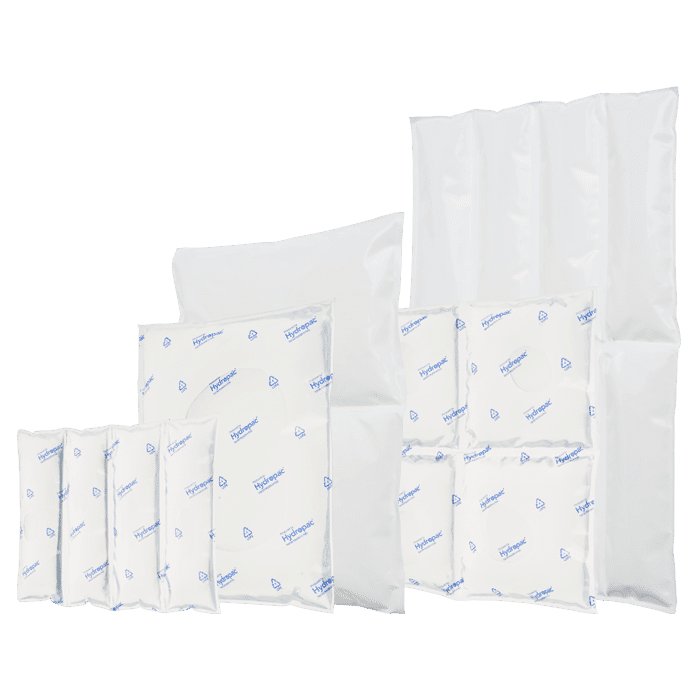
Hydropac offers every customer a customized solution for chilled and conditioned shipping. For example, we help a customer with limited freezing capacity to deliver gel packs frozen and ready to use, and we can manufacture almost all shapes and sizes of cooling elements. As a customer, you come first: we are here to help you.
What a Parcel Experiences Across a UK Year
Heat moves into a parcel in proportion to the temperature difference across its wall. Conductivity, surface area and wall thickness are all fixed once the box is chosen. The temperature difference is the only term that changes after the specification is signed off, and it is the one that moves most.
Summer: a gradient problem
Met Office areal series for 2025 record a UK mean daily maximum of 5.9 degrees C in January against 21.3 degrees C in July, with England warmer at 6.2 and 22.9 degrees C. The UK record high is 40.3 degrees C, set at Coningsby in July 2022.
Work the arithmetic for a chilled payload at 5 degrees C. At 15 degrees C ambient the driving difference is 10 degrees. At 30 degrees C it is 25 degrees. Conductive heat ingress scales with that difference, so it runs roughly two and a half times faster, and hold time falls to something closer to 40 per cent of what it was. A pack-out that held for 24 hours in spring is working to about 10 hours in a heatwave. That is a first order conduction figure rather than a full model, but it is the right order of magnitude and it explains why the failures cluster in the hottest week of the year, when order volumes are also at their highest.
Ambient is not what the parcel actually sees
There is a multiplier sitting on top of the weather that rarely makes it into a specification. A closed vehicle in sunshine does not sit at ambient temperature.
The closest controlled measurement comes from work on parked cars in summer sun, which found interior temperature rising at around 1.8 degrees C every five minutes, roughly 80 per cent of the total rise occurring within the first thirty minutes, and the interior reaching something in the order of 22 degrees above starting ambient after an hour. The rate of rise was largely independent of the starting temperature, so a mild 20 degree day still produces a punishing interior. A delivery vehicle in motion is not a parked car, so treat that as an indication of how fast an enclosed space heats rather than as a measurement of a courier van.
Delivery rounds, trailer staging, yard time and doorstep dwell all stack on to that. The realistic planning assumption is that the hottest hour of the journey is considerably hotter than any forecast, and that it tends to arrive near the end, when the coolant has least remaining to give.
Winter: a duration problem, and a freezing problem
Cold weather lowers the thermal load and lengthens the journey at the same time, which is why winter failures look nothing like summer ones.
Royal Mail neither collects nor delivers on UK bank holidays, and runs Monday to Saturday, so Saturday is a working day rather than part of the gap. Even so, a parcel that misses the Thursday collection before Easter can realistically sit until the Tuesday, which is five calendar days from despatch. Other carriers run different patterns, some including Sundays, so the worst case has to be worked out per service rather than assumed. That is the duration a winter configuration has to survive, and it falls in exactly the months when the product is more likely to freeze than to spoil.
Published work on postal networks makes the contrast unusually stark. In a study of data loggers shipped across three carriers in the United States against a 20 to 25 degrees C controlled room temperature requirement, packages were out of range for around 80 per cent of transit time in winter against 43 per cent in summer on the same service, with a recorded minimum of minus 14.9 degrees C and mean winter transit time roughly double the summer figure. The network is not the UK one, but the seasonal asymmetry it shows is the point.
Cold damage is the least tested failure mode in chilled distribution
A systematic review of vaccine distribution found around 16.7 per cent of shipments in developed countries exposed to freezing temperatures during transport, and studies covering complete distribution chains found between 75 and 100 per cent of shipments encountering freezing at some point. Freeze sensitive products do not recover from it. There is no equivalent of putting the product back in the fridge.
Food has the same problem in a different form. Chilling injury damages produce well above freezing point, and the thresholds are higher than most people expect: cucumber and aubergine suffer below roughly 10 degrees C, while banana, sweet potato, lemon and mature green tomato are damaged below roughly 13 degrees C. Emulsions split, some dairy separates, and a number of personal care and cosmetic formulations do not survive a hard freeze.
In almost every winter case we have looked at, the cause is the same: fully frozen coolant packed directly against the payload in a configuration designed for July. The parcel is not too cold because the weather is cold. It is too cold because nothing about the coolant changed when the weather did.


Running Two Configurations Without Complicating the Bench
There are only two honest responses to a 17 degree seasonal swing. Engineer one pack-out for the worst case in both directions and accept the cost for most of the year, or run two configurations and manage the changeover properly.
The second is almost always cheaper and is better supported by guidance than most businesses realise. WHO qualification guidance for shipping containers defines a seasonal packaging solution explicitly, as one whose effective performance requires more than one packing configuration, and sets it against a universal solution needing only one. The same guidance requires testing at minimum during the warmest and coolest parts of the year, and requires the temperature stabilising medium to be conditioned to an approved set point rather than simply taken out of a freezer, with the conditioning equipment holding that set point within plus or minus 3 degrees C.
That last requirement is the one that makes seasonal pack-outs work, and it is the one that gets dropped first.
Change the coolant, not the envelope
The instinct when designing a seasonal system is to change the box. We would advise the opposite. Keep the insulation envelope constant across the year and make the coolant the seasonal variable.
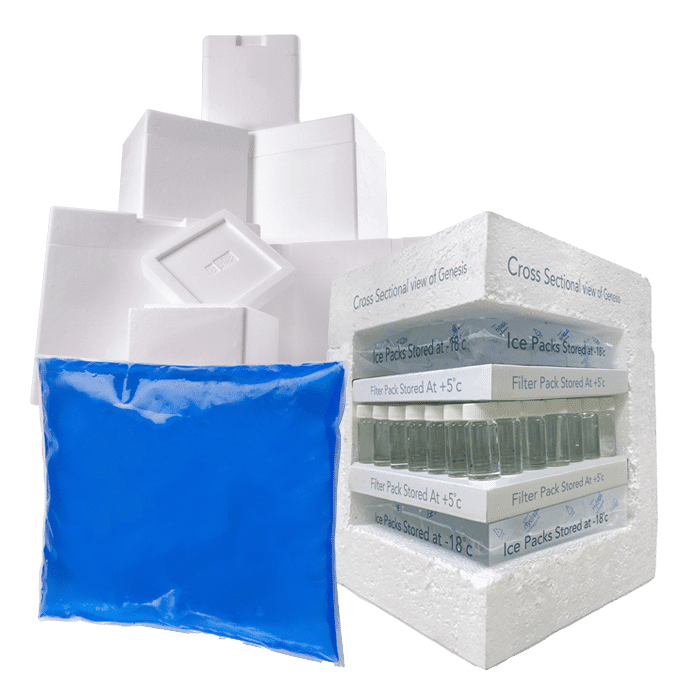
The reasoning is operational rather than thermal. A single insulated format such as a consistent Thermal Liner For Shipping or one specification of Insulated Food Packaging keeps purchasing simple, keeps carton sizes stable for the carrier tariff, and keeps the packing bench doing the same physical job in January as in July. What changes is how many packs go in, at what conditioned temperature, and where they sit relative to the payload.
In summer that means coolant mass sized against the peak gradient, fully frozen for maximum latent heat, and positioned above and around the payload so convection works with the design rather than against it. In winter it means less coolant mass but sized against a longer worst case dwell, conditioned to a controlled set point rather than hard frozen, and separated from the payload by a barrier layer or void fill so that nothing in the box sits in direct contact with a surface below zero.
The insulation, meanwhile, is doing the same job in both seasons. It is simply keeping cold out in one and keeping it in during the other.
Conditioning capacity is the constraint nobody budgets for
A controlled set point is not the same thing as a freezer, and this is where seasonal pack-outs most often fail in practice. Holding packs at a defined conditioning temperature requires either a second controlled space or a disciplined rotation through an existing one, and the throughput has to match daily despatch volume rather than average volume.
Coolant formulations also condition differently, which affects how long the rotation takes and how forgiving it is. Water Ice Packs change phase at the freezing point of water, which makes conditioning predictable and a chilled winter set point straightforward to specify. A frozen pack-out is a different exercise: a phase change formulation built for the frozen band, such as our own HydroFreeze, has to be taken fully through its phase change in a freezer cold enough to do it, and the dwell time depends on how cold that freezer runs. The conditioning temperature and times are set out on the product pages, and they are a capacity question as much as a seasonal one.
Where freezing or conditioning capacity is genuinely the limiting factor, it does not have to be solved in house. Because we manufacture rather than distribute, we can supply packs already frozen and ready to use, which removes the blast freezer from the critical path entirely. It is one of the more common fixes we implement, and it is usually cheaper than the alternative of buying capacity.
Make the changeover a trigger, not a date
Seasonal systems fail in operations far more often than in design, and the failure is almost always the same. A changeover date sits in a document that nobody owns, the weather does something inconvenient, and the bench keeps packing whatever it packed last week.
What works is a trigger tied to something observable: a forecast threshold, a rolling average of actual temperatures, or a fixed pair of changeover weeks reviewed each year against what the weather actually did. Behind the trigger, the configuration in use has to be visible at the bench without anyone reading a procedure. A different pack count, a different pack size, or a visibly different coolant does more for compliance than a paragraph in an SOP ever will.
It is also worth deciding in advance what happens in the three or four weeks either side of the changeover, because that is when a heatwave in early May or an unseasonal cold snap in October catches a business between configurations.
The legal band does not move with the weather
Worth restating, because it is the boundary the whole exercise sits inside. In England and Wales, food likely to support the growth of pathogens must be kept at 8 degrees C or below. Scotland applies a qualitative refrigeration requirement rather than a numeric limit. Quick frozen foods must be held at minus 18 degrees C or below, with brief transport tolerance to no warmer than minus 15 degrees C and retail display no warmer than minus 12 degrees C.
Industry practice targets tighter than the legal ceiling. The Chilled Food Association describes chilled foods as designed for storage at or below 8 degrees C while targeting 5 degrees C, because shelf life is set on the assumption that the chain holds throughout. A summer configuration designed to land on the 8 degrees C line leaves nothing in reserve for the yard, the round or the doorstep.
Test in both directions before committing
A summer profile confirming the payload stayed below its ceiling proves half the case. A winter profile confirming that nothing in the box froze proves the other half, and in our experience it is the half that has never been run.
Both belong in the same exercise. Our Cold Chain Optimisation process runs assessment, thermal testing and operational mapping against the routes a customer actually uses, then refines the pack-out and validates it before anything moves into production. For a seasonal specification that means two validated configurations, a documented changeover rule, and coolant quantities that were proven rather than estimated.
The related decisions sit alongside it. Material selection is covered in Vacuum Insulated Panels Versus EPS, and the frozen coolant question in Dry Ice Alternatives For Frozen Parcel Shipping. All three questions tend to arrive together, because they are the same question asked from different directions: what does this route actually demand of this parcel, and has anyone measured it.