
Vacuum Insulated Panels vs EPS: When the Premium Pays
Two figures are quoted for vacuum insulated panels, and both of them are correct. A new panel measured at the centre gives a thermal conductivity around ten times better than expanded polystyrene. The same panel measured as an installed component across its service life, edges and ageing included, gives four to five times. The first number belongs on a datasheet. The second belongs in a specification.
We work across this range rather than representing a single material, and we manufacture our own coolant and cooling elements in High Wycombe, so we have no commercial reason to push a specification upward or downward. What we do have is a consistent view that insulation should be chosen on the delivered system: the route, the payload, the coolant, the recovery model and the end-of-life route, assessed together.
Insulation for temperature-controlled packaging spans roughly an order of magnitude in thermal conductivity and considerably more than that in cost. The useful question is therefore not which material performs best in isolation. It is which material belongs on this lane, and what has to be true for it to earn its place.
Custom chilled solutions for you
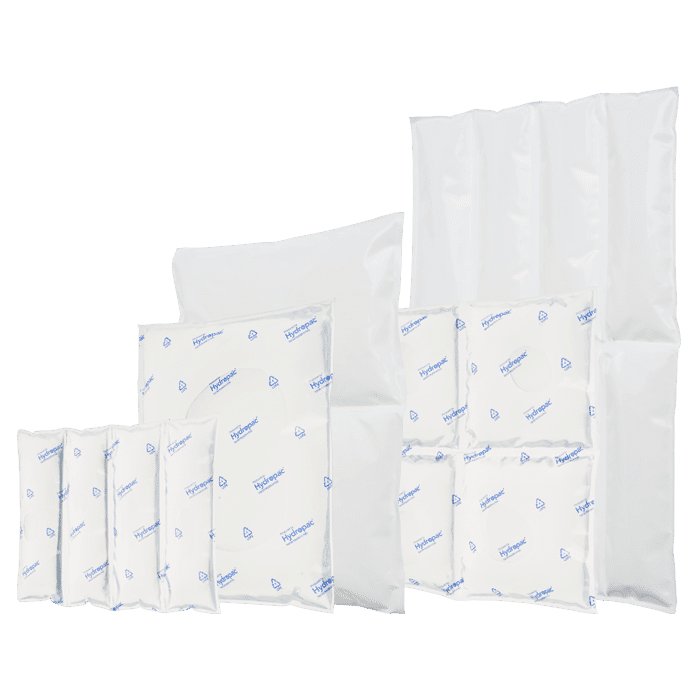
Hydropac offers every customer a customized solution for chilled and conditioned shipping. For example, we help a customer with limited freezing capacity to deliver gel packs frozen and ready to use, and we can manufacture almost all shapes and sizes of cooling elements. As a customer, you come first: we are here to help you.
What Lambda Tells You, and What It Leaves Out
Thermal conductivity, written as lambda and measured in watts per metre kelvin, is the standard basis of comparison, and lower is better. It is also the most over-interpreted number in the category, because it describes a material under laboratory conditions rather than a wall inside a parcel that is being stacked, handled and left in a yard.
Published values at around room temperature set out the working range.
|
Material |
Lambda, W/m.K |
Where it belongs |
|---|---|---|
|
Vacuum panel, fumed silica core, new |
0.0035 to 0.0045 |
The datasheet value, useful for comparison only |
|
Vacuum panel, aged over service life, centre of panel |
0.007 to 0.009 |
Ageing only; edge effects sit on top of this |
|
Rigid polyurethane and polyisocyanurate |
0.020 to 0.026 |
48 to 96 hour pharmaceutical and specialist food |
|
Expanded and extruded polystyrene |
0.030 to 0.038 |
24 to 72 hour chilled and frozen, wet payloads, robust handling |
|
Paper, wool, recycled cotton and rPET fibre liners |
0.035 to 0.045, rising with humidity |
Shorter chilled routes where end of life leads the decision |
|
Reflective foil and bubble laminate |
Around 0.04, but sold on assembly R values |
A facing layer with an air gap, not a wall on its own |
The vacuum panel argument is thickness before it is hours
Convert those lambdas into wall thickness at equal thermal resistance and the case becomes concrete. Taking 0.033 for polystyrene, 0.022 for polyurethane and 0.008 for an aged vacuum panel, matching a thermal resistance of about 1.15 m2K/W takes roughly 38 mm of polystyrene, around 25 mm of polyurethane, or a little over 9 mm of vacuum panel.
In a parcel that difference is substantial. Removing 30 mm from each wall returns around 60 mm on every external dimension, which becomes either payload volume or a reduction in the dimensional weight the carrier charges against. On high value air freight that is frequently where the vacuum panel case is won, and it is an argument about geometry rather than about hold time.
Panels are specified on their installed value for good engineering reasons
A vacuum panel is a microporous core held under vacuum inside a barrier laminate, and its behaviour in service follows directly from that construction. Designing around it is routine once the characteristics are understood.
Gas and moisture permeate the barrier film slowly but continuously. Published work puts the pressure rise at roughly 1 to 2 mbar per year and moisture uptake at under 0.2 mass per cent per year, depending on the barrier film and the panel size, with centre of panel conductivity drifting from about 0.004 when new towards 0.006 to 0.008 across a twenty five year design life. If the barrier is punctured the core reverts to roughly 0.020 at atmospheric pressure, which is why handling and inspection form part of any reusable vacuum panel system rather than an optional extra.
Then there is the perimeter. The barrier laminate conducts around the edge of each panel, and the effect is larger than most datasheets imply: measured vacuum panel walls have been recorded between 21 and 38 per cent below their calculated thermal resistance, and panel manufacturers note that a half metre square panel can show an effective heat transfer several times that of a very large one. Edge length per unit area rises as panels get smaller, so the penalty is most pronounced in parcel sized shippers, which is precisely where the panels are smallest.
Panels are also made to final size and cannot be trimmed in use. That is a manufacturing and planning consideration rather than a limitation, and it is one reason vacuum panel systems reward a settled, repeatable pack-out over a format that changes with every order.


Matching the Material to the Route
Insulation selection presents as a technical question and resolves as a commercial one. Once the thermal comparison is honest, the decision turns on two things: whether the packaging comes back, and what the coolant inside it is being asked to do.
Recovery rate is the number that decides a reusable system
Vacuum panel core material carries a cost premium over polystyrene of an order of magnitude or more per unit volume, and that premium is recovered across cycles rather than on any single shipment.
Industry estimates commonly put the break-even for a reusable thermal system somewhere in the region of five to twenty cycles. The width of that range is the point: it is set by assumptions about recovery and handling rather than by thermal performance, so the same system can look obvious or absurd depending on the operation it sits in.
Everything therefore depends on cycle count actually being achieved. Return transport at a cost comparable to the outbound leg, inspection at every cycle, and replacement of units damaged or not returned all push the crossover further out. A system replaced every ten cycles never reaches it.
That is why vacuum insulation is strongest in closed loop clinical and pharmaceutical supply, where the container is tracked, the return is contractual and the payload value justifies the handling. It is the same reason we would not specify it for an open courier network delivering to consumers who have no route to send anything back. Vacuum Insulated Panels and Reusable Thermal Packaging are built for the first case, and the question we ask first is what the measured recovery rate is.
Hold time comes from the coolant, not from the walls
There is a persistent assumption that better insulation buys proportionally more hours. It does not, and understanding why prevents a great deal of expensive over-specification.
Heat ingress is a function of conductivity, surface area, wall thickness and the temperature difference across the wall. Insulation influences two of those four terms. What actually holds a payload in band is the latent heat absorbed as the coolant changes phase, and once that phase change is complete the insulation slows the drift rather than preventing it.
Geometry compounds this in small parcels. Surface area scales with the square of the dimensions while payload volume scales with the cube, so a small shipper loses hold time disproportionately, and vacuum panel edge effects are most pronounced at exactly that size. It is the main reason a validated 40 litre system does not scale down arithmetically to a 4 litre version, and why we test each format rather than extrapolating between them.
In practice this means coolant specification deserves at least as much attention as insulation selection, and usually more. Where the payload sits in the chilled band, Water Ice Packs change phase at the freezing point of water and give a predictable, well understood profile. Where the product is frozen, or a chilled band has to be held tightly, Phase Change Materials are engineered to change phase at the temperature the product actually needs, from the chilled band through to the sub-zero point a frozen payload requires. No amount of wall thickness substitutes for getting that number right.
Where reflective materials belong
Reflective foil and bubble laminates are worth understanding properly, because they tend to be specified against the wrong number. The material itself has a modest but real thermal conductivity, in the region of 0.04 W/m.K. The headline figures quoted for these products are assembly values that depend on an adjacent air gap and on surface emissivity, rather than properties of the material on its own.
Independently measured, a typical foil faced bubble product comes out at around R-1.0 to R-1.1 in imperial terms, roughly 0.18 to 0.19 m2K/W. That is a genuine contribution in the right position and a long way short of a foam wall. Two conditions decide whether it earns its place: it needs the adjacent air gap to work, so a laminate compressed flat between a payload and a carton wall performs well below its specification, and it addresses radiant load specifically, which makes it most valuable on shorter routes with high radiant exposure or as a facing on another insulant.
Used in that role it performs exactly as intended, and that is the application ReflectiveAir Insulation is designed and manufactured for. Specified outside it, any reflective product will be judged against a job it was not built to do, which is a specification problem rather than a material one.
End of life belongs in the specification, not after it
Recyclability is now a design input rather than a disposal question, and the practical test is separability. Under the Recyclability Assessment Methodology, components that can easily be separated by hand are assessed separately, while components that cannot be are assessed under the predominant material by weight. A vacuum panel is a metallised barrier film around a silica core and is not hand separable, so it is assessed as a single item rather than as its parts. That is a design decision, and it is cheaper to make it at specification stage than to revisit it later.
Polystyrene has a more nuanced story here than its reputation suggests. The EPS industry body reports that around two thirds of the EPS packaging disposed of in the UK was recycled in 2023, and densification equipment reduces transport volume enough to make collection economic at all. What the material still lacks in most areas is convenient collection: not every household waste recycling centre accepts it, and kerbside collection is rarer still. The honest framing is the gap between technically recyclable and practically collected, which is the same distinction we drew in Recycled Insulation Materials and Performance Trade-Offs.
Classification and fee treatment under the current producer responsibility regime depend on how a specific construction is assessed, so those should be confirmed against statutory guidance and with your compliance scheme for the fee year in question rather than assumed from the material alone. What we can say with confidence is that construction affects the assessment, and that it is cheaper to design for it than to reclassify afterwards.
Four questions that settle most specifications
In our assessment work the same four questions resolve the majority of insulation decisions without anyone needing to compare datasheets. How long must the payload stay in band under a realistic worst case rather than an average one. Does the packaging return, reliably enough and cheaply enough to reach a useful cycle count. Is dimensional weight or internal volume a binding constraint on this lane. And how will the construction be treated at end of life.
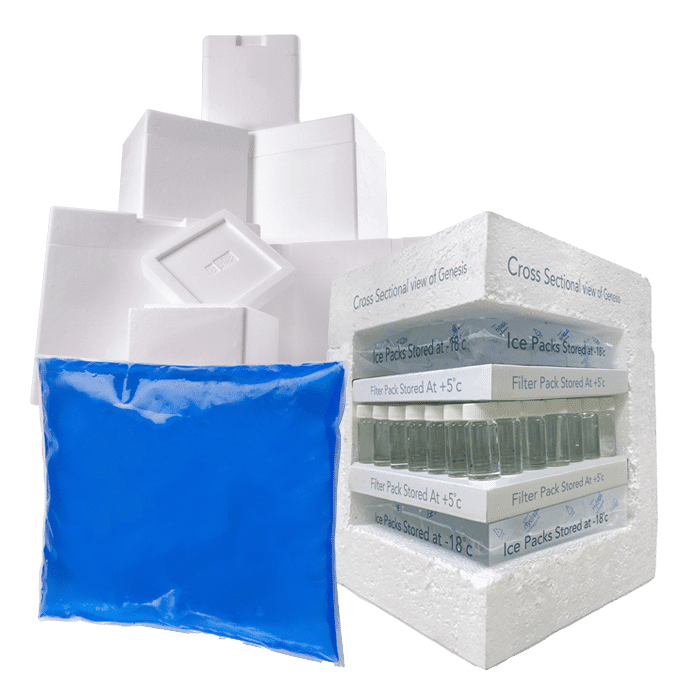
Answered honestly, those four tend to select the material on their own. A great deal of UK chilled and frozen e-commerce lands on well specified foam or fibre with correctly sized coolant, which is why Insulated Shipping Boxes and Polystyrene Boxes remain the backbone of the category. Long duration, high value, recovered pharmaceutical lanes are where vacuum insulation repays its premium properly. Both answers are correct, on different routes.
Because we make our own coolant and work across the insulation range rather than representing one material, the specification is not a sales decision. Our Cold Chain Optimisation process runs the cheaper option first: assess the current pack-out, apply thermal testing against the real route, refine coolant and format, then validate and move it into production. A fair number of reviews end with less insulation and better coolant sizing rather than more of both, and those are usually the ones that pay for themselves fastest.
The right insulation is the one that matches the route, the recovery model and the way the material will be handled at the end of its life. It is rarely the one with the lowest lambda on paper, and the full range of Cold Chain Insulation Materials is worth reviewing against the payload before that assumption is made.