
UN3373 Specimen Shipping: P650 and Temperature Control
There are two ways a Category B shipment can fail, and the guidance almost always covers only one of them.
Packing Instruction P650 exists to protect the people who handle the parcel. It sets out triple packaging, absorbent material, an itemised list, a minimum external dimension, marking and performance testing. Followed properly, it means that a courier who drops a box does not become a patient. What it does not do, anywhere in its text, is guarantee that the sample inside is still fit to analyse when it reaches the laboratory.
That second failure has become far more common as diagnostic volume has shifted into courier and postal networks. Home testing kits, decentralised trials, private phlebotomy, veterinary diagnostics and direct-to-patient sampling are all packed by people who are not dangerous goods specialists, and shipped through networks that were never designed around a 2 to 8 degrees C requirement. A rejected sample is rarely recorded as a packaging failure. It is recorded as a repeat collection.
What follows builds a P650 kit one layer at a time, noting at each layer both what the instruction requires and what it implies for design. It then deals with the part the instruction leaves to you, which is the temperature the specimen actually needs.
Custom chilled solutions for you
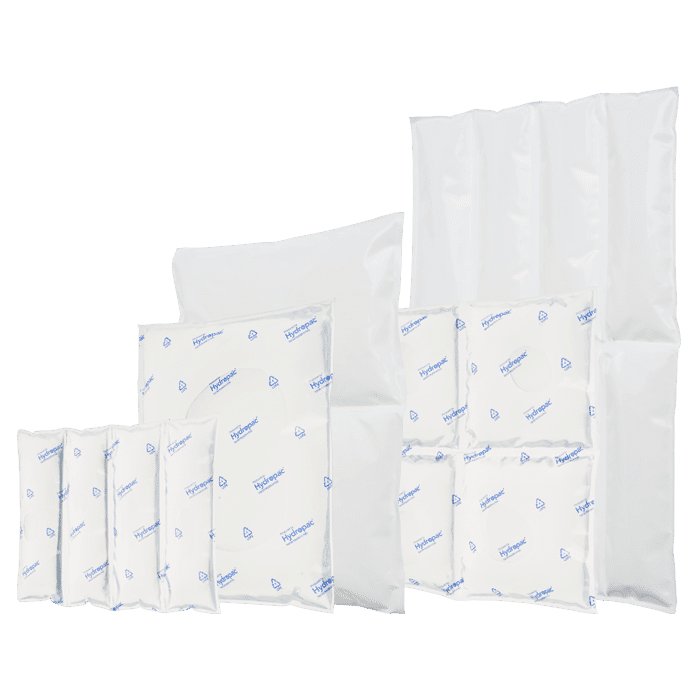
Hydropac offers every customer a customized solution for chilled and conditioned shipping. For example, we help a customer with limited freezing capacity to deliver gel packs frozen and ready to use, and we can manufacture almost all shapes and sizes of cooling elements. As a customer, you come first: we are here to help you.
Building a P650 Kit, Layer by Layer
Before the layers, one classification point. UN3373 covers infectious substances that do not meet Category A criteria, carried under the proper shipping name BIOLOGICAL SUBSTANCE, CATEGORY B. Category A material travels as UN2814 or UN2900 under P620, which requires UN specification packaging and third party certification, and is a different exercise entirely.
Department for Transport guidance reads the exempt specimen provision narrowly. It applies where material is known not to contain pathogens, and because that is seldom determinable in practice, the guidance steers towards treating human and animal material as UN3373 by default. For a kit that will be assembled by a patient at a kitchen table, default is the only sensible planning assumption.
Layer one: the primary receptacle
The primary receptacle holds the specimen and must be leakproof for liquids or siftproof for solids. Where residual liquid may be present in a nominally solid sample, the liquid rules apply. The instruction also permits up to 30 mL of Class 3, 8 or 9 dangerous goods per primary receptacle where this is needed to maintain viability, stabilise the sample, prevent degradation or neutralise a hazard, which is what allows a stabilising medium or a fixative to travel inside the kit.
The design consequence sits in a clause further down the instruction: the primary receptacle and the secondary packaging must maintain their integrity at the temperature of the refrigerant used, and at the temperatures and pressures that could result if refrigeration were lost. A tube that is perfectly sound at 4 degrees C may become brittle against dry ice, so a decision about coolant is also a decision about the primary, and about what happens when the coolant runs out.
Layer two: absorbent material
For liquids, absorbent material goes between the primary and the secondary in a quantity sufficient to absorb the entire contents of the primary receptacles. For solids it is required only where residual liquid may be present. Where several fragile primaries share one secondary, they must be individually wrapped or separated so they cannot break each other.
This layer is routinely under-specified because it is costed as a consumable rather than as a control. The capacity that matters is capacity under compression, at the bottom of a stacked parcel, not capacity measured flat on a bench.
Layer three: the secondary packaging
The secondary must also be leakproof for liquids and siftproof for solids. By road under ADR, either the secondary or the outer has to be rigid. By air the outer packaging itself must be rigid, which is worth knowing before a kit designed for a courier run is offered as an airfreight option. It is the secondary that carries the burden in the drop test, and it is the secondary that the coolant sits outside of.
Layer four: the itemised list
For air transport an itemised list of contents is enclosed between the secondary packaging and the outer packaging. Not inside the secondary, where it would be contaminated by a leak, and not loose in the outer where it can be lost. It is a small requirement that fails audits more often than any of the structural ones, usually because a kit was designed with nowhere sensible to put it, and it is good practice to build the space in even where the route is domestic road.
Layer five: coolant, and the clause that changes the design
Ice and dry ice go outside the secondary packaging, in the outer or in an overpack. Liquid nitrogen is handled separately, with its own requirements on the primary receptacle and on the applicable transport rules. Then comes the requirement that changes how a refrigerated kit should be built: interior supports must secure the secondary packaging in its original position after the ice or dry ice has dissipated.
Read that carefully, because it means the package is judged on its condition at the end of the journey rather than at despatch. A box packed tightly on Monday, with the coolant filling the void, can be half empty by Wednesday with the secondary sliding loose inside it. Nothing about the packaging changed. It still no longer complies.
Two related requirements follow from the same logic. Where wet ice is used, the outer packaging or overpack must itself be leakproof, which in a liquid specimen shipment means three leakproof layers rather than two. Where dry ice is used, the packaging must permit carbon dioxide gas to escape. What happens next depends on the mode, and this catches people out: by air the dry ice is UN1845 under its own packing instruction, with a Class 9 label and the net mass declared, while by road under ADR it is not carried as a dangerous good in its own right and the asphyxiation provisions apply instead. For UK domestic sample transport, which is overwhelmingly road, that distinction matters.
Layer six: the outer, its marks and its performance
The outer needs at least one surface measuring 100 mm by 100 mm. The UN3373 mark is a square set on point with sides of at least 50 mm, line width of at least 2 mm and characters at least 6 mm high, with the proper shipping name marked adjacent to it in letters at least 6 mm high.
The completed package must withstand a drop from not less than 1.2 metres in any orientation with no leakage from the primary receptacle. For liquids, the primary receptacle or the secondary packaging must also withstand an internal pressure differential of 95 kPa without leakage. P650 is performance based rather than certification based, so unlike P620 there is no UN specification marking. The consignor carries the evidence burden instead, which means the test records, the filling and closing instructions and the packaging specification are the compliance file.
The volume limits that only apply in the air
One correction worth making, because it constrains a great many UK operations for no reason. The limits of 1 litre per primary receptacle and 4 litres or 4 kg per outer package are additional requirements for air transport under IATA and ICAO, and that quantity expressly excludes ice, dry ice or liquid nitrogen used to keep specimens cold. P650 as applied to road and rail under ADR sets no equivalent per-package quantity limit at all.
Consolidating specimens onto a domestic road run is therefore not capped at 4 litres. Businesses that built a packing SOP around that figure have usually restricted their own throughput without needing to.


The Decision P650 Leaves to You
Having built a compliant package, you still have to answer a question the instruction never asks: what temperature does this specimen actually need, and for how long. Getting that wrong produces a parcel that satisfies every regulator and fails the laboratory.
Refrigeration is not automatically correct
The instinct in kit design is to add a cold pack and consider the problem solved. Published UK reference laboratory guidance does not support that as a general rule, and the expectations differ by analyte.
Serology, blood and serum samples are expected to travel at ambient temperatures of 10 to 25 degrees C with a maximum transit of 72 hours, moving to 2 to 8 degrees C only for storage on arrival and to minus 20 degrees C or below for longer holding. Swabs in viral transport medium are similarly ambient with a 72 hour ceiling, so the binding variable there is transit time rather than temperature. Molecular work on EDTA plasma or serum requires separation by centrifugation within four hours of collection, after which ambient is acceptable if the sample moves promptly, and freezing is the alternative, with more than three freeze and thaw cycles putting results at risk.
Urine for culture, covered by UK Standards for Microbiology Investigations rather than the virology guidance above, is the case where refrigeration genuinely earns its place: processing within four hours, or refrigeration where the delay extends to 48 hours, unless a boric acid preservative is used, in which case the bacterial population holds steady for 48 to 96 hours without cooling. Tissue for virology goes frozen, with room temperature samples unreliable for RNA viruses in particular.
There is also a case where cooling makes matters worse. Whole blood awaiting separation is better held at ambient than refrigerated, because cooling suppresses the sodium potassium pump in the red cells and drives potassium out into the plasma. A well-intentioned cold kit can manufacture a spurious potassium result that reads like a clinical finding. Time still matters in either direction, since potassium can begin to drift in unseparated whole blood within the hour, which is why the separation window is the control that actually protects the result.
What a temperature failure costs downstream
Haemolysis is the most clearly quantified example. At 4.5 g/L of free haemoglobin, potassium rises by an average of around 1.48 mmol/L, lactate dehydrogenase runs roughly four and a half times higher than at 0.27 g/L, and aspartate aminotransferase around two and a half times higher. Both LDH and AST are affected below the concentration at which haemolysis becomes visible, so a sample can look entirely acceptable on the bench and still carry a materially wrong number into a clinical decision.
Set that against a widely cited estimate putting the pre-analytical phase at between 46 and 68 per cent of total laboratory error, and transit stops looking like a logistics line item. It is one of the few stages in the chain where a packaging specification changes a result.
The postal network is not a cold chain, and says so
For UK kit designers this is the single most consequential constraint, and it is published rather than inferred. The postal route accepts UN3373 on domestic services only, caps total sample volume or mass at 50 mL or 50 g in any one parcel, requires P650 compliant packaging, restricts sending to qualified medical, dental, veterinary or nursing professionals or a recognised laboratory, and prohibits frozen water and dry ice outright.
A network that will not carry frozen water cannot carry a refrigerated specimen in any meaningful sense. Any kit intended to return by post is therefore an ambient-stable kit by definition, and the design problem moves upstream into stabilising media, preservative chemistry and turnaround time. Where a genuine 2 to 8 degrees C requirement exists, the route has to change with it, which usually means a courier account and a pack-out built to survive a weekend rather than a working day.
Designing the kit backwards, which is the only order that works
The sequence we recommend runs in reverse of the one most projects use. Start with the analyte and its stability window. Establish the realistic worst case transit time, including a Friday despatch and a bank holiday weekend. Decide from those two facts whether temperature control is required at all, or whether a stabilising medium removes the requirement and simplifies everything downstream. Only then choose coolant, format and outer.
Run in that order, the packaging decisions become straightforward. Run in the usual order, they become a series of compromises made after the kit has already been specified.
Where the coolant fits, and where it does not
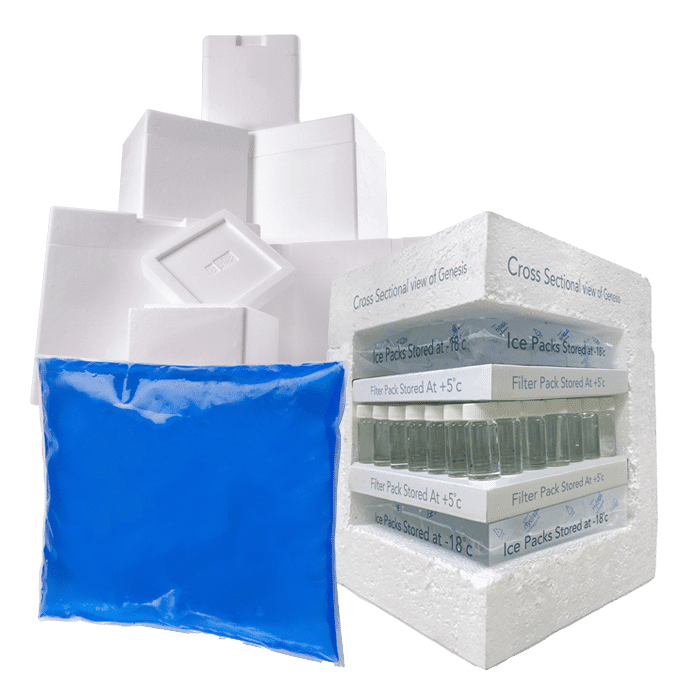
It is worth being precise about what a coolant contributes to a Category B shipment. The triple packaging, the leakproof primary and secondary, the absorbent, the rigid outer and the drop and pressure performance all have to be met by the packaging system the consignor specifies, tests and documents. A coolant pack does not make a parcel compliant, and an insulated mailer on its own is not a UN3373 package.
What the coolant does decide is whether the specimen arrives inside its stability window, and it has to be chosen with the instruction in mind. It sits outside the secondary, in the outer or an overpack. The secondary still has to be held in its original position once the coolant is spent. And the coolant has to suit the temperature the analyte actually needs, which for many samples is ambient protection rather than refrigeration.
That is the part we help with. We produce, seal and quality control our coolant in house at High Wycombe, so fill weight, footprint and format can be matched to the secondary and outer a laboratory has already specified, rather than the kit being redesigned around whatever coolant happens to be available. Medical Ice Packs are built for that role: conditioning the specimen, not replacing the packaging around it. Where the temperature record is part of the data, as it is for clinical trial material, the coolant choice then belongs in thermal testing against the real route through our Cold Chain Optimisation process.
The regulatory position is stable, which is not the same as safe
The WHO transport guidance for 2025 to 2026 has applied since October 2025, and the current IATA edition introduced no substantive change to P650 or to dry ice handling. Classification guidance for infectious substances is flagged for 2027, but P650 itself has been notably stable.
That stability is worth understanding correctly. The risk in Category B shipping is not that the rules move under you. It is that the rules are met in full and the sample still arrives unusable, because nothing in them was ever about the analyte. Compliance and integrity are two separate design objectives, and only one of them is written down for you.