
“Food Safe” but tested how exactly?
“Food safe” is not a marketing phrase
The term “food safe” is widely used across the cold chain sector. It suggests suitability, compliance and low risk. What it does not always explain is how that safety claim is verified.
Water-based ice packs are, by design, placed close to food contact packaging. If leakage occurs, the quality of that water becomes relevant. It is not sufficient to assume that treated or filtered water is inherently safe. Verification is required.
At Hydropac, water used in our ice packs is processed through UV treatment and multi-stage filtration during manufacture. More importantly, samples from production runs are submitted to independent public health laboratories for microbiological analysis.
Testing includes recognised indicator organisms such as:
- E. coli
- Enterococci
- Coliform bacteria
These are standard markers used in public health water quality assessment to identify contamination risk. This is not internal sampling. It is independent, third-party verification conducted by accredited public health laboratories.
This level of scrutiny involves additional operational cost. It also creates accountability. If independent water testing is not part of your supplier’s documented process, then “food safe” is a claim, not a standard.
Across the cold chain sector, performance is often measured in hours held and degrees maintained. Microbiological verification is discussed far less frequently. Yet when something goes wrong, it is rarely the temperature chart that is questioned first.
Custom chilled solutions for you
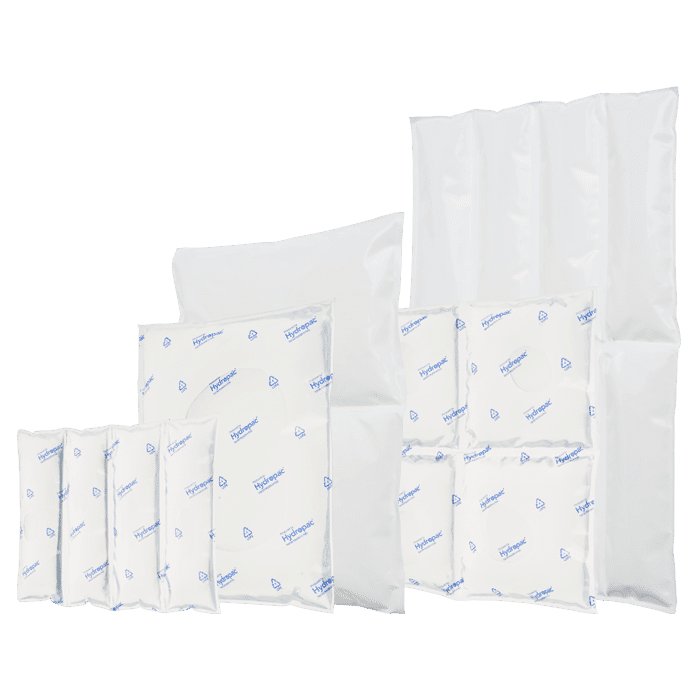
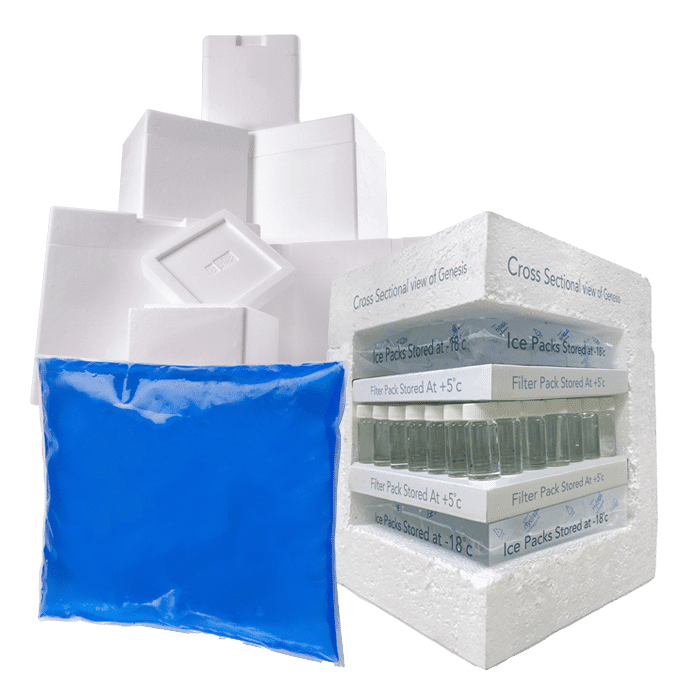
Hydropac offers every customer a customized solution for chilled and conditioned shipping. For example, we help a customer with limited freezing capacity to deliver gel packs frozen and ready to use, and we can manufacture almost all shapes and sizes of cooling elements. As a customer, you come first: we are here to help you.
Temperature stability does not eliminate microbiological risk
Hydropac manufactures water-based ice packs and phase change materials for chilled and frozen food distribution, pharmaceutical transport and healthcare logistics. Thermal performance remains central to our engineering approach. Predictable phase change temperatures, consistent freeze-down behaviour and durable sealing technology are fundamental to product design.
However, temperature stability does not address every risk variable. A coolant that performs thermally but lacks documented microbiological verification leaves a gap in the safety chain.
Cold chain packaging performs two critical functions: maintaining temperature and protecting product integrity. The latter includes physical durability, chemical compatibility and microbial cleanliness.
Performance charts demonstrate thermal capability. Independent laboratory testing demonstrates responsible manufacturing.
Both are necessary.
Independent testing is a commercial choice
Submitting production samples to accredited public health laboratories for microbial analysis is not a regulatory shortcut. It is a deliberate decision to exceed minimum expectations.
In a competitive market, there is constant pressure to reduce cost and streamline production. External microbiological testing adds cost and administrative complexity. It is not always visible to the end customer. It does not make a headline on a specification sheet.
It does, however, provide documented evidence that water quality has been verified against recognised microbiological indicators.
The difference between internal assurance and independent verification is significant. One relies on process control. The other adds external scrutiny.
For brands operating in regulated food and pharmaceutical sectors, that distinction matters.
The question supply chain teams should ask
If you are purchasing temperature-controlled packaging, the conversation should extend beyond hold time and price per unit.
It is reasonable to ask:
- Is the water inside the coolant independently tested?
- Which laboratory performs the analysis?
- Which microbial indicators are assessed?
- How frequently are batches verified?
If those questions cannot be answered clearly and with documented evidence, then you are relying on assumption rather than verification.
Familiarity with a supplier is not the same as due diligence. Long-term relationships do not replace documented standards. In regulated food and pharmaceutical supply chains, assumption is a risk variable.
Verification removes it. Documentation proves it.


A higher standard for cold chain integrity
Cold chain integrity is not defined solely by performance curves. It is defined by the standards that sit behind the product.
Stable temperature protects product quality. Verified water quality protects brand reputation and consumer confidence. One without the other is incomplete.
At Hydropac, we believe that responsible temperature-controlled packaging must address both.
Standards are not defined by what is claimed. They are defined by what is proven. Because in modern food and healthcare logistics, safety is not assumed. It is demonstrated.