
Shipping Wet Payloads Without Leaks or Soggy Boxes
Every performance figure in packaging is measured dry. Board strength is rated at 50 per cent relative humidity. Liner thermal performance is quoted at ambient conditions. Compression ratings come from samples conditioned in a standard atmosphere before they ever meet a payload.
None of that describes the inside of a fish parcel on day two. Fish, shellfish, raw meat, soft cheese and cut produce all arrive at the packing bench carrying liquid and generate more of it in transit. Drip loss, purge, condensation and melt water collect in the same place, which is the bottom of the box, and they do it for the entire journey.
A wet payload is therefore a different engineering problem from a cold one, and it is the one more often got wrong. We see pack-outs that hold temperature impeccably and still lose the parcel, because the carton softened, the liner saturated, the label ran and raw protein ended up in contact with something it should not have touched. For a business selling direct to the consumer, that is a refund, a review and a food safety question arriving together.
The most useful way to design for it is to follow the liquid, stage by stage, and see where it does its damage.
Custom chilled solutions for you
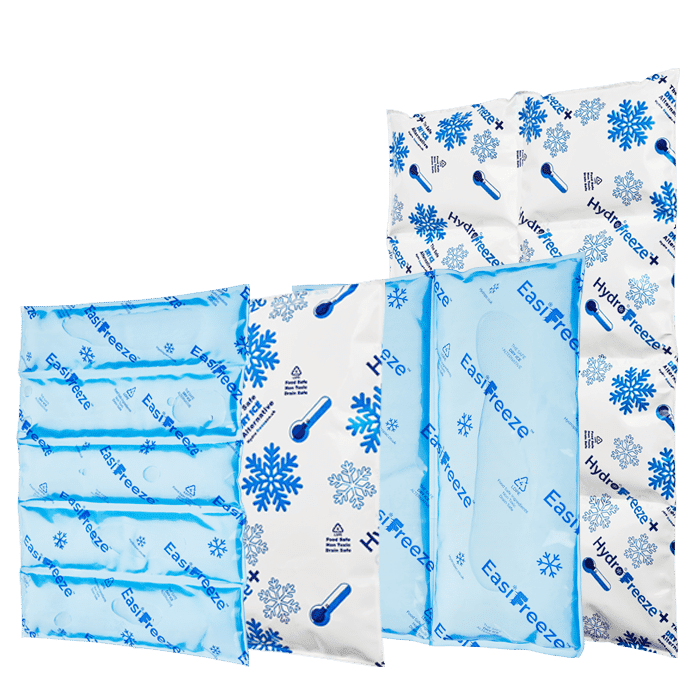
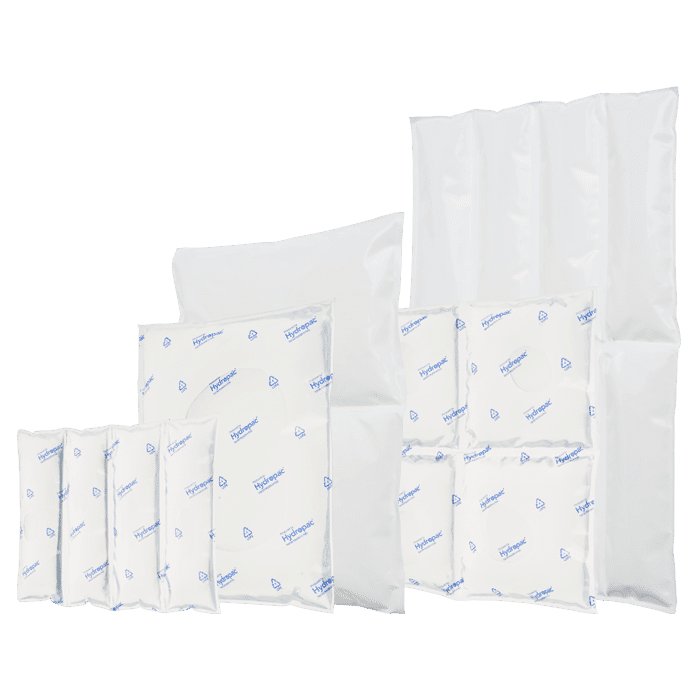
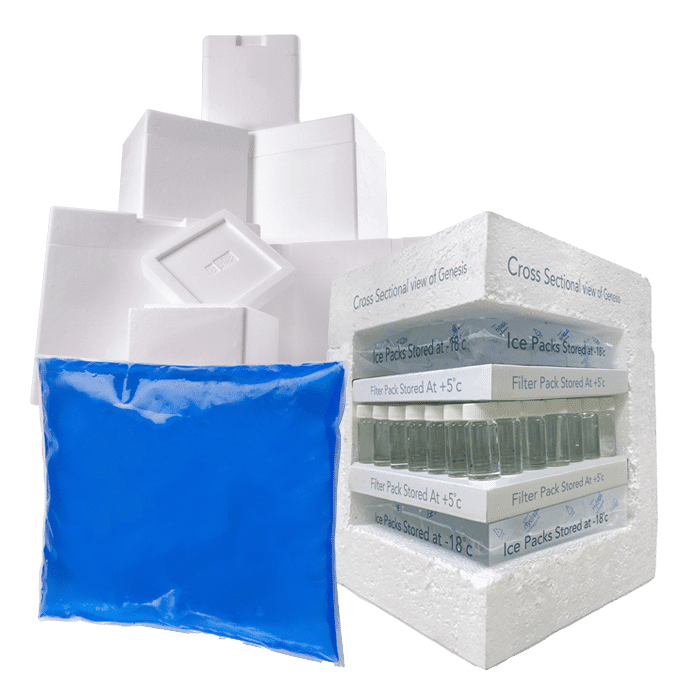
Hydropac offers every customer a customized solution for chilled and conditioned shipping. For example, we help a customer with limited freezing capacity to deliver gel packs frozen and ready to use, and we can manufacture almost all shapes and sizes of cooling elements. As a customer, you come first: we are here to help you.
Follow the Liquid: Where a Wet Parcel Fails
Start with volume, because most pack-outs are implicitly designed as though the answer were close to zero.
At the bench: more liquid than anyone specifies for
CSIRO work on chilled vacuum packed beef primals puts normal drip loss at 1 to 2 per cent of weight, with pieces subject to cutting and trimming reaching around 2 per cent and small retail portions and sub-primals recorded between 5 and 10 per cent. Published work on salmon fillets stored on ice puts drip loss in the region of 1 to 2 per cent over two weeks. Anything that has been frozen and thawed loses considerably more.
Apply those figures to a 2 kg parcel and the design target is somewhere in the order of 20 to 100 mL of free liquid from the product alone, and up to roughly 200 mL where heavily cut retail portions are involved, before condensation on the liner and before any melt water. That is a puddle rather than a damp patch, and it will be present from the first few hours onward.
In the trailer: the carton is weaker than its rating
Edge crush and box compression figures are measured under controlled conditions that a chilled parcel never sees. Edge crush specimens are conditioned to the standard paper and board atmosphere of 23 degrees C and 50 per cent relative humidity under ISO 187 and tested to ISO 3037, while whole filled boxes are compression tested to ISO 12048 after conditioning of the complete package.
The interior of a chilled parcel is nowhere near 50 per cent relative humidity. It is close to saturation. Published work from Georgia Tech gives a working rule that a ten point change in relative humidity produces around a ten per cent change in compression strength, and puts box compression loss at 80 per cent relative humidity at 32 per cent using the Fibre Box Association loss factor, or 27 per cent using the author’s own model.
So a carton specified to a given stacking load is running at roughly two thirds of its rated strength for most of the journey. Put that in the bottom row of a stacked cage and the failure is not bad luck. It is the arithmetic working as expected on a specification that was never adjusted for the condition it would meet.
In the van: temperature and time compound each other
In England, Wales and Northern Ireland, food likely to support pathogen growth must be kept at 8 degrees C or below. Scotland applies a qualitative requirement instead of a numeric limit. Fresh fishery products carry a stricter expectation again: under the assimilated food hygiene regulation they must be maintained at a temperature approaching that of melting ice, and separate provisions on packaging and on transport require that melt water must not remain in contact with the products.
That second clause is a packaging instruction hiding inside a food regulation, and it rules out any design where the product sits in a tray collecting whatever drains into it. It is also the clearest illustration of why wet payload design is a regulatory matter and not simply a housekeeping one.
The spoilage data explains why industry practice targets 0 to 5 degrees C rather than the legal ceiling. Packed cod holds around 14 days at 0 degrees C, 6 days at 5 degrees C and 3 days at 10 degrees C. Salmon runs roughly 11.8 days at 0 degrees C against 8 days at 5 degrees C. For Listeria monocytogenes, moving from 4 to 8 degrees C cuts the time to reach a given cell density by 60 to 65 per cent in milk and cream and by 75 to 80 per cent in minced beef and smoked salmon.
A parcel arriving at 7 degrees C is entirely legal. It has also spent its journey roughly halving the shelf life the customer was promised on the label, which is a commercial failure rather than a compliance one and is felt just as sharply.
On the doorstep: the leg nobody controls
Food business operators must have procedures based on HACCP principles, and dwell time after the courier leaves falls squarely inside that duty. We could find no published UK guidance setting a specific time limit for a chilled parcel left in a safe place, which means the business assesses and justifies it rather than pointing at a rule.
It is also common. Polling by Opinium for Citizens Advice, covering 8,011 UK adults with fieldwork in September and October 2024, found that around 36 per cent of people who had received a parcel in the previous month had experienced a problem with it, including parcels left in insecure locations and parcels arriving late. For a chilled food parcel neither of those is an inconvenience. Both are temperature events, and they occur at the point in the journey where the coolant has least capacity left.

Specifying Backwards From the Failure
Once you accept that the parcel will be wet, the design order changes. Containment comes first, hygiene separation second, temperature third. The usual order is precisely the reverse, which is how a business ends up with a thermally excellent box that leaks.
Give every layer exactly one job
The most reliable wet payload pack-outs we build are layered, and each layer does one thing. The product wrap or vacuum pack holds purge at source and keeps raw items separate from one another. An absorbent pad sized against expected drip takes up free liquid and keeps the product out of it. A sealed liner or bag inside the insulation stops liquid ever reaching the insulation or the board. The insulation envelope controls heat ingress for the route duration. The outer carton is specified for the humidity it will actually contain rather than the humidity it was tested in.
Failures cluster where one component has been asked to do two jobs. A liner expected to insulate and to contain liquid will eventually do neither well, because the material properties that make a fibre good at trapping air also make it good at holding moisture. That component becomes the single point of failure for the whole parcel.
Absorbency is a specification, not a consumable
If the parcel will generate 50 mL, absorbent capacity needs to exceed 50 mL with margin, and it needs to hold that volume under compression rather than release it when the box is stacked or tipped on its side in a cage.
This is also where liner choice and hygiene intersect. Natural fibre liners absorb moisture readily, which genuinely helps buffer humidity, but a liner that has absorbed product liquid is contaminated rather than merely damp. It is not reusable in any sense a customer should be encouraged to consider, and where the fibre is encased in a film sleeve it is the film rather than the fibre doing the containment. The integrity of that sleeve, not the insulating value of what is inside it, is what a wet payload specification should actually be testing.
Why coolant integrity matters more with raw protein
Food contact law sets the frame. Under the assimilated Regulation 1935/2004, materials in contact with food must be manufactured under good manufacturing practice so that, under normal or foreseeable conditions of use, they do not transfer constituents to food in quantities which could endanger human health, bring about an unacceptable change in the composition of the food, or bring about a deterioration in its organoleptic characteristics.
A coolant pack is not normally a direct food contact item. A ruptured coolant pack resting against unwrapped raw protein is a foreseeable condition, and that is the scenario a specification should be tested against rather than the normal one. It is a different question from whether a pack is food safe in ordinary use, and it is the question that actually determines what happens to the order.
This is where manufacturing matters more than sourcing. Seal integrity is a production variable, not a product feature: it depends on film specification, seal geometry, sealing temperature and the consistency of the process. We produce, seal and quality control our packs at High Wycombe precisely so that those variables are ours to control, and our packs are made to withstand repeated freeze and thaw cycles without leaking or losing shape. For wet payloads that matters more than it does anywhere else in the cold chain, which is why Leak Proof Ice Packs and Food Safe Ice Packs are worth specifying deliberately rather than by unit price.
What is inside the pack matters as much as the seal around it, because the contents determine what has to be assessed if that seal ever fails. That assessment belongs in the specification, documented before the first shipment rather than reconstructed after a complaint. Our position on coolant choice is set out on the No Gel, Just Water page and compared in detail in Gel Versus Water Ice Packs, and where the thermal requirement allows, Water Ice Packs are the straightforward option for unwrapped raw protein.
Separation inside a single parcel
Government guidance on food delivery asks businesses to identify cross contamination risks in the delivery process, and gives the example of packing items securely and keeping allergen free meals separate in transit so that spillages cannot reach them. That guidance is written around prepared meals rather than mail order raw ingredients, so it sets the direction rather than the detail. We could find no published UK code of practice that specifies how raw and ready to eat items should be separated inside a single parcel, which leaves each business to justify its own approach under its HACCP based food safety management system.
The defensible version is simple enough to train. Raw goes low, sealed and individually wrapped. Ready to eat goes high, sealed, ideally in a separate inner bag. Absorbency sits under the raw layer rather than under everything. And the pack sequence is written down, because this is the control that quietly degrades on the busiest day of the week.
Design for the parcel that goes wrong
The practical conclusion from following the liquid all the way to the doorstep is that the stated transit time is the beginning of the calculation rather than the end. A wet payload pack-out needs enough margin to survive a missed delivery and several hours in a porch, and enough structural margin to survive a saturated carton in the bottom of a cage.
That is a testable proposition rather than a judgement call, and testing it is what our Cold Chain Optimisation process exists to do: assess the current pack-out, run thermal testing and operational mapping against the real route, refine coolant, absorbency and format together, then validate before it goes into production. For wet payloads we would rather do that with the actual product than with a simulated payload, because purge volume and how it behaves in the box are difficult to model and simple to measure.
The format decisions follow from the result rather than preceding it, whether that lands on Chilled Food Shipping formats, on Fresh Produce Cold Packs, or on a moulded pack geometry made to fit a specific tray. Dry packaging tests tell you how a box behaves on a bench. Only a wet payload tells you how it behaves on a doorstep, and that is the test the customer is running on your behalf every time you despatch.