
Who Pays for Packaging Waste?
For years, packaging waste sat quietly in the background of supply chain operations. It existed, it carried a cost, but for most businesses, that cost felt indirect. Local authorities managed disposal, recycling systems absorbed much of the operational burden, and packaging decisions were largely driven by performance and procurement economics. That model has changed. Extended Producer Responsibility, or EPR, shifts who pays for packaging waste in the UK. The cost now sits far more directly with the businesses placing packaging into the market. For food and pharmaceutical brands operating temperature-controlled supply chains, that shift is becoming impossible to ignore. What makes this particularly interesting is that the impact is not being felt equally across industries. Food brands and pharmaceutical companies are approaching EPR from very different operational and commercial realities. One is reacting quickly because of immediate cost exposure. The other is moving more cautiously because of risk, validation, and compliance constraints. Both, however, are now facing the same question “Is our cold chain packaging still commercially sustainable in the EPR era?”
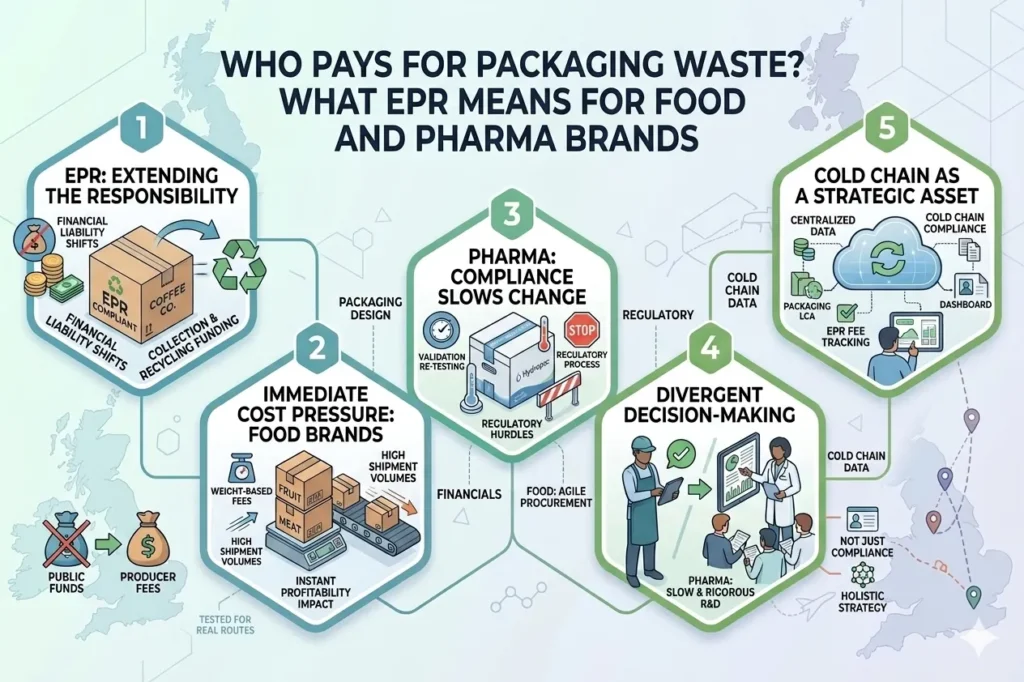
Five Key Takeaways
- EPR shifts the financial responsibility for packaging waste from local authorities to producers and supply chain businesses.
- Food brands are feeling immediate cost pressure due to high shipment volumes and weight-based packaging fees.
- Pharmaceutical businesses face different challenges, with validation and compliance slowing packaging change.
- Decision-making ownership differs significantly between sectors, influencing how quickly businesses can adapt.
- The brands gaining advantage are treating EPR as a strategic cold chain issue, not just a compliance exercise.
What EPR Actually Changes
At its simplest level, EPR transfers the cost of managing packaging waste from taxpayers and local authorities back onto producers.
That includes the cost of:
- Collection
- Sorting
- Recycling
- Disposal of household packaging waste
According to the UK Parliament’s EPR briefing, the reforms are expected to cost businesses more than £1 billion annually, fundamentally reshaping how packaging decisions are made across supply chains.
For many businesses, this sounds straightforward in theory. In practice, it has major implications for cold chain operations because temperature-controlled shipments tend to involve:
- Multiple packaging components
- High material weight
- Complex, difficult-to-recycle materials
- Large volumes of single-use packaging
This is where the financial pressure begins to build.
Cold chain packaging decisions made five years ago may no longer make commercial sense today.
The Cold Chain Problem Nobody Really Talked About
One might say that cold chain packaging escaped detailed scrutiny because it was viewed as operationally essential. If additional coolant reduced temperature risk, it was considered justified. If adding another gel pack protected against a worst-case delivery delay, most businesses accepted the trade-off without much debate.
But we can see how EPR is changing that mindset.
Now, every additional gram of packaging carries a measurable financial implication. Suddenly, overpackaging is no longer just inefficient. It is expensive. And nobody wants that.
This is particularly important for temperature-controlled packaging because coolant is often the single heaviest element within the shipment. A standard gel pack may contain only a few grams of plastic film, but hundreds of grams of gel contents. Under EPR, that weight matters.
In other words, the packaging decisions businesses barely questioned five years ago are now directly affecting margin.
Food Brands: Immediate Cost Pressure and Fast Decisions
The food sector is already feeling the impact sharply.
This is largely because food businesses tend to operate high-volume shipment models with relatively tight margins. Those meal kits we all love, chilled grocery delivery, artisan food subscriptions, and direct-to-consumer chilled brands all move large quantities of packaging into the market every day.
Even relatively small increases in packaging-related cost quickly become material when scaled across thousands of weekly shipments.
For many food brands, the operational conversation has shifted rapidly from:
“What protects the product best?” to “What protects the product efficiently and cost effectively?”
In food supply chains, packaging decisions are often led by operations and procurement teams. The pressure is commercial and immediate. Businesses are actively looking for opportunities to reduce:
- Packaging weight
- Coolant usage
- Transport cost
- Fulfilment complexity
- EPR exposure
This is why food brands are generally adapting more quickly. The financial signals are already visible in day-to-day operations.
Pharma Brands: Slower Change, Different Pressure
Pharmaceutical businesses face a very different reality but are feeling the pressure too.
While EPR still affects cost, packaging decisions within pharma are rarely driven primarily by procurement alone. They are heavily influenced by quality assurance, regulatory compliance, validation processes, and patient risk considerations.
This changes the pace of adoption significantly. In pharmaceutical cold chains, packaging systems are often validated through extensive testing and approval procedures. Once a solution is approved, changing it can require:
- Revalidation
- Stability assessments
- Documentation updates
- Regulatory review
- Risk analysis
As a result, even when there is a clear commercial argument for optimisation, implementation may move more slowly.
This does not mean pharma businesses are ignoring EPR. Far from it. It simply means the balance between risk and efficiency is approached differently.
Where food brands may optimise quickly to reduce cost pressure, pharma businesses often move cautiously to ensure compliance and product integrity are not compromised.
Why Decision Ownership Matters
We often see that one of the most overlooked aspects of EPR is how internal ownership affects decision-making.
In food businesses, procurement and operations teams have greater influence over packaging strategy. Decisions can therefore be implemented relatively quickly when a commercial benefit is identified.
In pharmaceutical organisations, the process is usually more layered. QA, regulatory, and compliance functions play a central role, meaning packaging changes require broader internal alignment.
Neither approach is inherently right or wrong. They simply reflect different operational realities.
What matters and needs to stay top of mind is whether businesses are evaluating packaging decisions using current data rather than historic assumptions.
The organisations adapting most effectively are the ones bringing operations, procurement, compliance, and supply chain teams together around a shared understanding of total cold chain cost.
The businesses adapting fastest to EPR are bringing procurement, operations, compliance, and supply chain teams together around a shared understanding of cost.
The Shift from Packaging Cost to System Cost
One of the biggest changes that needs to take place is looking beyond packaging unit price alone.
A cold chain discussion might have focused on the cost per gel pack or insulated box. But today, the more important question is: “What is the total cost of this packaging system across the entire supply chain?”
That includes:
- Packaging weight
- Transport cost
- EPR exposure
- Operational handling
- Fulfilment efficiency
- Temperature performance
- Waste generation
This is where many organisations are finding opportunities they had not previously considered.
A packaging system that appears more expensive at unit level may actually reduce overall supply chain cost if it lowers shipment weight or simplifies fulfilment processes.
Equally, a system that appears operationally safe may be significantly over-engineered for the actual delivery environment.
As EPR reshapes cold chain economics, the question is no longer just whether your packaging works. It’s whether your entire cold chain system is still fit for the future.
How can Hydropac help?
At Hydropac, we see this shift every day.
Businesses are no longer just looking for packaging products. They are looking for clarity. They want to understand whether their current cold chain still makes sense commercially, operationally, and from a compliance perspective.
That requires a different type of conversation.
Rather than simply recommending products, our approach focuses on understanding the real operational conditions behind the shipment. That includes:
- Transit lanes
- Duration variability
- Seasonal changes
- Product sensitivity
- Packaging weight
- Operational handling realities
From there, we help businesses identify where systems can be simplified, optimised, or redesigned without compromising performance.
In many cases, the biggest improvements do not come from radical changes. They come from removing inefficiencies that have gradually become embedded over time.
For food and pharmaceutical businesses, that changes how packaging decisions need to be made.
Some organisations will continue treating EPR as a compliance obligation and absorb the rising cost. Others will use it as an opportunity to redesign their cold chain around efficiency, performance, and long-term sustainability.
The difference between those two approaches will become increasingly visible over the next few years.