Hidden Hygiene Risks in Cold Chain Infrastructure
Cold chain performance is often measured by temperature control: whether products stay within specification, remain protected in transit, and rely on validated packaging.
But temperature is only part of the risk. Even a shipment that stays perfectly within range can be compromised if hygiene controls fail along the way.
In food and pharmaceutical supply chains, contamination usually builds through small oversights across warehouses, staging areas, transport equipment, and handling processes. These risks are often hidden in plain sight, but they can directly affect product safety, compliance, and customer trust.
As supply chains become more complex, businesses need to look beyond temperature and rethink what cold chain risk really means.
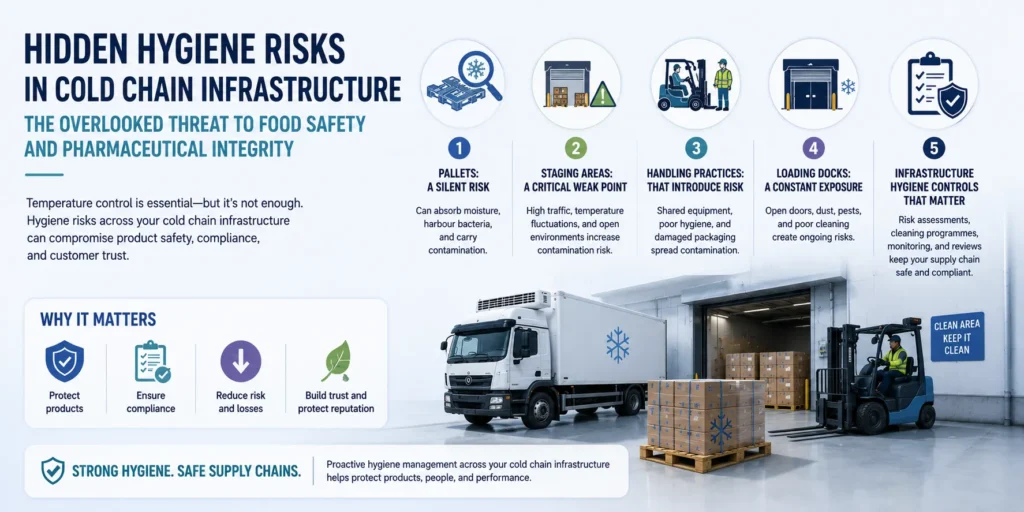
Five Key Takeaways
- Hygiene risks within the cold chain often originate from infrastructure and handling practices rather than packaging itself.
- Pallets, staging areas, loading docks, and handling equipment can become significant contamination points if not properly managed.
- Food and pharmaceutical supply chains face different compliance requirements, but both depend on robust hygiene controls throughout the cold chain.
- Industry standards such as HACCP, BRCGS, GDP, and MHRA guidance all emphasise environmental controls and contamination prevention.
- Businesses that proactively assess hygiene risks across their cold chain infrastructure are better positioned to reduce compliance risks, product losses, and reputational damage.
Temperature Control Does Not Automatically Mean Product Protection
One of the most common misconceptions in cold chain operations is that maintaining temperature automatically guarantees product quality.
The truth is that temperature control and hygiene control are closely linked but entirely separate disciplines.
A pallet of chilled food products may remain within specification throughout its journey, but if it has been exposed to contaminated surfaces or poor handling practices, temperature compliance alone does not eliminate the risk.
Similarly, pharmaceutical products can remain within validated temperature ranges while still being exposed to environmental contamination risks that compromise product integrity.
This distinction is increasingly important because regulators are paying greater attention to holistic supply chain controls rather than focusing solely on temperature monitoring.
The UK’s Food Standards Agency (FSA), BRCGS Global Food Safety Standard, and Goods Distribution Practice (GDP) guidelines all emphasise the importance of maintaining clean, controlled environments throughout storage and distribution activities.
The message is clear: temperature is only one part of product protection.
The Pallet Problem Nobody Talks About
Pallets are among the most overlooked hygiene risks within the cold chain.
They are also among the most widely used.
Every day, pallets move through warehouses, production facilities, transport networks, distribution centres, and retail environments. Along the way, they come into contact with countless surfaces, environmental conditions, and handling equipment.
Yet many businesses rarely assess pallets as a potential contamination source.
Wooden pallets, in particular, present several challenges:
- They can absorb moisture
- They are difficult to clean effectively
- Cracks and splinters can harbour bacteria and contaminants
- They may carry contamination from previous environments
For food manufacturers operating under BRCGS standards, pallet condition and cleanliness form an important part of site audits because pallets can directly affect product safety.
The pharmaceutical industry faces similar concerns. While secondary packaging may provide protection, contaminated pallets can still create environmental risks within storage and distribution facilities.
This does not necessarily mean wooden pallets should never be used. However, it does mean businesses should have clear controls around pallet sourcing, inspection, cleaning, and segregation.
Need an audit of your cold chain? Reach out to our team for more information.
Staging Areas: A Critical Weak Point in the Cold Chain
If there is one area that consistently creates hidden risk across both food and pharmaceutical operations, it is the staging area.
Staging areas often exist in a grey zone between storage and transport.
Products may spend only a short period there before dispatch, which can create a false sense of security.
However, this is frequently where multiple risk factors converge:
- Increased personnel movement
- Open doors
- Temperature fluctuations
- Mixed product categories
- Vehicle loading activity
- Packaging handling
In busy operations, staging areas can become bottlenecks during peak periods. Products may remain exposed for longer than originally intended, particularly when dispatch schedules are disrupted.
From a hygiene perspective, staging areas should be viewed as controlled environments rather than temporary holding zones.
Best practice includes:
- Clearly defined product flow routes
- Segregation between waste and finished goods
- Scheduled cleaning regimes
- Controlled access procedures
- Environmental monitoring where appropriate
These measures are often inexpensive to implement but can significantly reduce contamination risk.
Cross-Contamination Through Handling Practices
One of the most difficult risks to identify is human behaviour.
Most contamination incidents are not caused by deliberate negligence. They occur because people are operating within busy environments where competing priorities exist.
Common examples include:
- Handling waste before handling finished products
- Shared equipment between different operational zones
- Poor hand hygiene practices
- Inconsistent cleaning procedures
- Inadequate staff training
The challenge is that these risks rarely appear in temperature data.
A shipment may complete its journey without a single temperature excursion while still being exposed to avoidable contamination risks during handling.
This is why food safety frameworks such as HACCP place significant emphasis on process controls and critical control points rather than relying solely on end-product testing.
The same philosophy underpins pharmaceutical GDP guidance, which requires businesses to maintain appropriate environmental and operational controls throughout distribution activities.
Why Food and Pharma Face Different Challenges
While food and pharmaceutical supply chains share many common hygiene principles, the operational risks often manifest differently.
Food Supply Chains
Food businesses typically face heightened risks associated with:
- Microbial contamination
- Cross-contamination between product categories
- Moisture management
- Product spoilage
- Environmental cleanliness
The consequences are often immediate and highly visible.
Product recalls, customer complaints, shelf-life reductions, and food waste can quickly create commercial and reputational damage.
According to the Food Standards Agency, foodborne illness affects approximately 2.4 million people annually in the UK, highlighting the importance of robust food safety controls throughout the supply chain.
Pharmaceutical Supply Chains
Pharmaceutical businesses are generally more focused on:
- Product integrity
- Controlled environments
- Documentation and traceability
- Regulatory compliance
- Risk management
While contamination events may be less visible than food spoilage, the consequences can be equally significant.
GDP guidance issued by the MHRA requires medicinal products to be stored, transported, and handled under conditions that prevent contamination, deterioration, or mix-ups throughout the distribution process.
This means hygiene controls extend far beyond the packaging itself.
Compliance Standards That Businesses Should Understand
One of the clearest signs that hygiene risks are becoming a greater priority is the emphasis placed on them within industry standards.
HACCP
Hazard Analysis and Critical Control Points remains the foundation of food safety management.
HACCP requires businesses to identify and control potential contamination risks throughout operational processes, including storage and distribution activities.
BRCGS Global Food Safety Standard
BRCGS places significant focus on:
- Site hygiene
- Environmental controls
- Equipment cleanliness
- Product segregation
- Risk assessment
Businesses seeking certification must demonstrate effective controls throughout the supply chain.
Good Distribution Practice (GDP)
GDP guidelines for pharmaceuticals require organisations to maintain:
- Clean storage facilities
- Controlled environments
- Documented procedures
- Staff training programmes
- Risk-based quality systems
These controls are designed to protect medicinal products throughout storage and transportation.
MHRA Expectations
The MHRA expects pharmaceutical distributors to demonstrate robust controls around hygiene, handling, traceability, and environmental management as part of GDP compliance.
Increasingly, inspectors are assessing whether businesses have adopted a risk-based approach rather than relying solely on documented procedures.
The Cost of Getting It Wrong
Businesses often view hygiene controls as a compliance requirement.
The reality is that poor hygiene can have direct commercial consequences.
These may include:
- Product recalls
- Customer complaints
- Regulatory action
- Product write-offs
- Supply chain disruption
- Increased audit findings
- Brand damage
According to Stevens Traceability, recent data indicates that food recalls can cost anywhere from £1 million in typical direct expenses, with many serious cases running up between £2.5 million and £5 million once investigation, disposal, lost sales, and reputational damage are considered.
For pharmaceutical organisations, the cost of non-compliance can be even greater due to the regulatory implications involved.
When viewed through this lens, proactive hygiene management becomes far more than a compliance exercise. It becomes a business continuity strategy.
If your business regularly reviews packaging performance but rarely audits pallets, staging areas, or handling practices, there may be hidden risks sitting elsewhere within your cold chain.
What Leading Businesses Are Doing Differently
The most resilient food and pharmaceutical supply chains are moving beyond siloed thinking.
Rather than treating hygiene, packaging, transport, and compliance as separate disciplines, they are increasingly evaluating the cold chain as a connected system.
This typically involves:
- Routine infrastructure audits
- Environmental monitoring
- Pallet management programmes
- Enhanced staff training
- Supplier hygiene assessments
- Risk-based operational reviews
Importantly, they recognise that many contamination risks originate before products ever leave the facility.
Cold chain performance is not determined solely by packaging design. Understanding how products move through facilities, staging areas, and transport networks often reveals opportunities to reduce risk that temperature monitoring alone cannot identify.
Hydropac's Perspective
At Hydropac, we believe effective cold chain management requires looking beyond the shipment itself.
Packaging plays a critical role for ice packs, but it exists within a much larger operational environment. Pallets, handling procedures, facility design, staging practices, and transport operations all influence product outcomes.
The businesses achieving the strongest compliance performance are rarely those focused on a single risk factor. They are the organisations that understand how multiple small risks interact across the entire cold chain.
By adopting a broader view of hygiene and operational risk, businesses can strengthen compliance, improve product protection, and build greater resilience into their supply chains.
Temperature remains one of the most important variables within the cold chain, but it is not the only one.
As food and pharmaceutical supply chains continue to evolve, hidden hygiene risks within infrastructure and handling practices are attracting greater attention from regulators, auditors, and customers alike.
Pallets, staging areas, handling equipment, and operational processes may not be the most visible elements of the cold chain, but they often have a disproportionate influence on product safety and compliance.
The businesses that proactively assess and manage these risks will be better positioned to protect product quality, maintain regulatory compliance, and build stronger, more resilient supply chains in the years ahead.
If you’re reviewing your cold chain strategy this year, don’t stop at packaging and temperature performance. Assessing hygiene risks throughout the wider infrastructure may reveal opportunities to strengthen compliance and reduce risk that have been hiding in plain sight. Contact our team for an audit of your cold chain.