
Future-Proofing the Cold Chain: Why Single-Use Gel Is Being Penalised
For years, the cold chain industry has operated with a fairly straightforward mindset: if adding more packaging reduced risk, then adding more packaging was usually considered the sensible thing to do. An extra gel pack here. A thicker liner there and a “just in case” adjustment added after one difficult summer period or a delayed courier run. Anyone who has spent enough time around temperature-controlled logistics will recognise how these decisions build up over time. The problem is that they rarely get revisited later. What starts as a temporary precaution gradually becomes standard operating procedure. For a long time, that approach was tolerated because the commercial consequences were relatively small. Packaging costs were manageable, disposal responsibility sat elsewhere, and very few businesses were measuring the total impact of adding more material into the system.
That environment no longer exists.
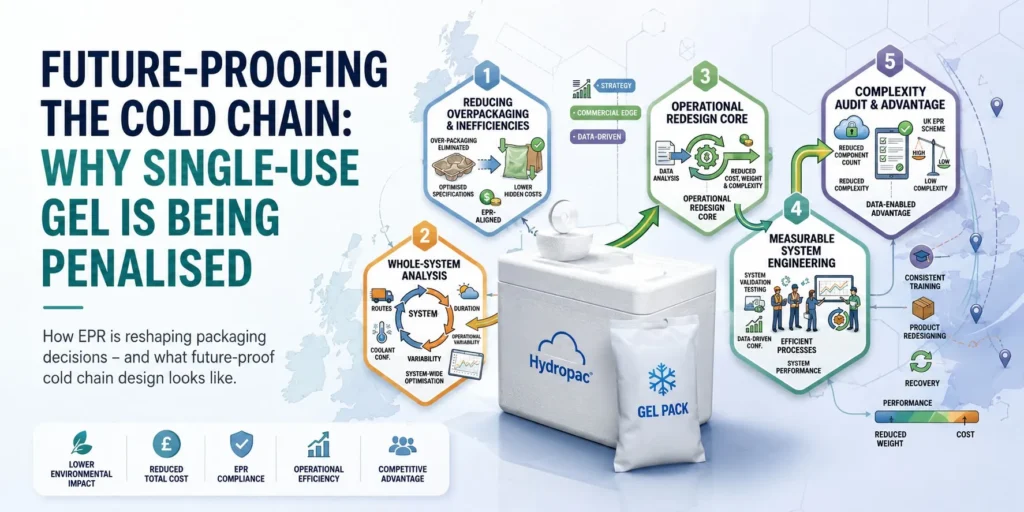
Five Key Takeaways
- Single-use gel packs are becoming commercially and environmentally harder to justify under EPR.
- Gel is unlikely to disappear completely, but its use will become far more targeted and selective.
- Returnable cold chain systems work well in closed-loop environments but often fail in open consumer delivery models.
- Future-proof cold chains will focus on lighter materials, right-sized packaging, and integrated system design.
- The brands moving first are already redesigning packaging formats, trialling water-based systems, and evaluating total system cost.
Extended Producer Responsibility is changing how cold chain packaging is evaluated, and it is exposing inefficiencies that many businesses have carried quietly for years. Materials that are heavy, difficult to recycle, and designed for single use are now attracting much greater scrutiny. At the same time, transport costs continue to rise, sustainability expectations are increasing, and operational margins are becoming tighter across both food and pharmaceutical supply chains.
This is where things start to become uncomfortable for single-use gel systems.
Not because gel suddenly stopped performing, but because the commercial and environmental cost of using it at scale is becoming harder to justify.
Many cold chains are still operating with packaging decisions made years ago under very different commercial conditions.
Why Gel Is Coming Under Pressure
The pressure on gel-based systems is not being driven by a single trend. It is the result of several industry shifts colliding at the same time.
Under EPR, businesses are increasingly responsible for the full cost of managing packaging waste.
For cold chain operators, the challenge is particularly acute because coolant is often the single heaviest element within the shipment. A standard gel pack may contain only a small amount of plastic film but several hundred grams of gel contents. Under EPR, that weight matters.
The issue becomes even more significant at scale. A few pence per shipment may feel relatively minor in isolation, but across tens of thousands of weekly deliveries it quickly becomes material.
At the same time, transport economics are amplifying the problem. Industry estimates suggest that relatively small increases in shipment weight can increase logistics costs by between 5 and 10 percent, particularly within last-mile delivery networks.
What was once viewed as a low-cost operational component is now affecting:
- Packaging compliance costs
- Transport spend
- Fulfilment efficiency
- Sustainability reporting
- Margin performance
And that is before businesses even begin considering customer perception.
“EPR is not changing how cold chains work. It is changing which inefficiencies businesses can still afford to ignore.”
The Industry Is Starting to Reassess Old Assumptions
One of the more interesting shifts happening right now is that businesses are beginning to challenge packaging assumptions that have existed for years without much scrutiny.
Historically, gel packs developed a reputation as the “safe” option. If a shipment contained pharmaceuticals, travelled long distances, or involved high-value products, gel was often treated as the default answer.
In practice, many of those decisions were driven more by habit and perceived risk than by measured operational data.
At Hydropac, we do not believe gel is inherently a superior cooling solution. In many applications, water-based systems can perform equally effectively when the overall cold chain has been engineered properly. The issue is not usually the filling type itself. It is whether the system as a whole has been designed around real operational conditions.
That distinction matters because many cold chains are still heavily over-specified.
A shipment travelling for four hours often carries packaging designed for twenty-four. Seasonal conditions change, delivery routes evolve, and courier performance improves or deteriorates over time, yet packaging configurations frequently remain untouched for years.
The result is a system carrying unnecessary material, unnecessary weight, and increasingly unnecessary cost.
Will Gel Disappear Completely?
Probably not, and it is important to be realistic about that.
There will continue to be applications where gel remains appropriate, particularly in highly specialised pharmaceutical environments or where very specific thermal profiles are required. The cold chain industry is unlikely to move towards a single universal packaging solution because operational requirements vary too significantly from one supply chain to another.
What is much more likely is that gel becomes increasingly targeted rather than universally applied.
The broad, default use of single-use gel packs across every shipment type is becoming harder to defend commercially, particularly within high-volume direct-to-consumer food distribution where shipment volumes are large and operational margins are already under pressure.
This is where we expect the most visible shift to happen first.
Businesses shipping thousands of chilled deliveries every week are already beginning to ask more detailed questions about packaging weight, transport efficiency, and EPR exposure. In many cases, they are discovering that the packaging systems they inherited no longer align with the commercial realities they are operating in today.
The Returnable Packaging Question
Whenever discussions around single-use packaging begin, returnable systems are usually positioned as the obvious long-term solution. On paper, the logic is appealing. Reusable packaging appears to reduce waste, improve sustainability credentials, and reduce dependence on disposable materials.
In some supply chains, this works extremely well.
Closed-loop systems where packaging moves predictably between controlled locations can support returnable models effectively because the logistics are stable and user behaviour is manageable. This is often the case within certain healthcare or pharmaceutical distribution environments.
Consumer delivery systems are a very different reality. The challenge is rarely the packaging itself. The challenge is everything surrounding it. Consumers forget to return packaging. Reverse logistics become expensive. Storage, cleaning, redistribution, and tracking create operational complexity that many businesses underestimate initially.
What works neatly in theory often becomes much messier in practice.
This is why many open-loop returnable systems struggle to scale commercially, particularly within fragmented direct-to-consumer environments.
That does not mean reusable packaging has no role in the future of the cold chain. It simply means businesses need to evaluate solutions based on operational reality rather than sustainability optics alone.
What Future-Proofing Actually Looks Like
One of the biggest misconceptions in the market is that future-proofing means replacing one material with another. In reality, the businesses adapting most successfully are taking a much broader approach.
Future-proof cold chain design is increasingly centred around three key principles.
- Lighter Systems
Reducing unnecessary shipment weight is becoming a major commercial priority. This does not mean compromising protection. It means engineering systems that achieve the required thermal performance with less material.
In many cases, businesses are discovering that they have historically overpacked shipments because systems were designed around worst-case assumptions rather than measured lane performance.
Future-proofing the cold chain is no longer just about maintaining temperature performance. It’s about balancing protection, efficiency, compliance, sustainability, and total system cost together. Review your cold chain with our Cold Consult tool.
- Right-Sized Packaging
A surprisingly common issue within cold chain operations is the use of identical packaging configurations across completely different delivery conditions.
Signs a cold chain may be over-specified often include:
- Standardised pack-outs across all delivery routes
- Additional gel packs added over time “just to be safe”
- No seasonal variation in packaging design
- Packaging decisions based on historic assumptions rather than transit data
- Excessive coolant weight relative to actual journey duration
The businesses making meaningful progress are increasingly designing packaging around real-world conditions rather than blanket assumptions.
- Integrated System Design
The future of the cold chain will not be defined by using less packaging. It will be defined by using packaging more intelligently.
That means understanding how insulation, coolant placement, shipment duration, handling conditions, and transport variability work together as a complete system.
The businesses seeing the greatest gains are no longer evaluating packaging components in isolation. They are looking at:
- Total shipment cost
- Total packaging weight
- Operational handling efficiency
- EPR exposure
- Transport performance
- Sustainability impact
This is where the real optimisation opportunities now sit.
The Cost of Doing Nothing
One of the biggest risks for businesses right now is assuming they have time to postpone these conversations.
The commercial pressure on heavy single-use packaging is unlikely to reduce over the next few years. If anything, it is likely to intensify as EPR reporting becomes more sophisticated and transport costs continue to rise.
Businesses that continue operating heavily over-specified cold chains are likely to face pressure from multiple directions at once:
- Rising EPR costs
- Increased transport spend
- Greater operational inefficiency
- More complex reporting requirements
- Growing scrutiny around packaging waste
- Increasing customer expectations around sustainability
Individually, each pressure point may feel manageable. Together, they begin to reshape the economics of the cold chain entirely.
There is also a growing reputational element to consider. According to Deloitte’s Sustainable Consumer research, more than 70 percent of UK consumers say sustainability considerations influence purchasing decisions. In direct-to-consumer food delivery particularly, packaging is highly visible. Customers physically interact with it every time an order arrives at their doorstep.
Businesses that fail to evolve may increasingly find themselves commercially and culturally out of step with the wider market.
What Smarter Brands Are Already Doing
Some of the most forward-thinking businesses are already beginning to adapt, not because regulation has forced them to, but because the economics are starting to make the direction obvious.
Across the industry, we see businesses that are:
- Redesigning pack formats to reduce unnecessary weight
- Trialling water-based cooling systems where appropriate
- Reviewing actual transit lane data more closely
- Reducing coolant quantities through better insulation design
- Evaluating packaging based on total system cost rather than unit price alone
Perhaps most importantly, they are becoming more willing to challenge long-standing assumptions that previously went unquestioned.
The conversation is shifting from:
“Does this packaging work?” to “Does this packaging still make commercial sense?”
That is a very different mindset from the one that shaped many cold chains over the last decade.
Hydropac’s View On Things
At Hydropac, we do not believe the future of the cold chain will be defined by a single material or packaging format. We believe it will be shaped by smarter system design, more accurate operational data, and a much clearer understanding of total cold chain cost.
That means helping businesses engineer systems around real transit requirements rather than inherited assumptions, while balancing compliance, operational efficiency, sustainability, and performance in a much more integrated way.
The businesses that future-proof successfully will not necessarily be the ones using the least packaging. They will be the ones using packaging more intelligently, designing systems around real operational conditions rather than assumptions, and recognising that cold chain performance is now inseparable from cost, compliance, and sustainability.