
Correct Packing Techniques for Temperature-Controlled Shipments
5 Key Takeaways
- Successful temperature-controlled shipments depend on the entire packaging system, not just the coolant or insulation used.
- Many cold chain failures occur because businesses focus on packaging products rather than pack-out design, validation, and operational processes.
- Product preparation, coolant placement, and shipment geometry often have a greater impact on performance than the packaging materials themselves.
- Cold chain packaging validation is essential for both food and pharmaceutical supply chains, particularly as delivery networks and operational conditions evolve.
- Leading businesses are increasingly optimising packaging systems around real transit data rather than worst-case assumptions, helping reduce cost, waste, and compliance exposure.
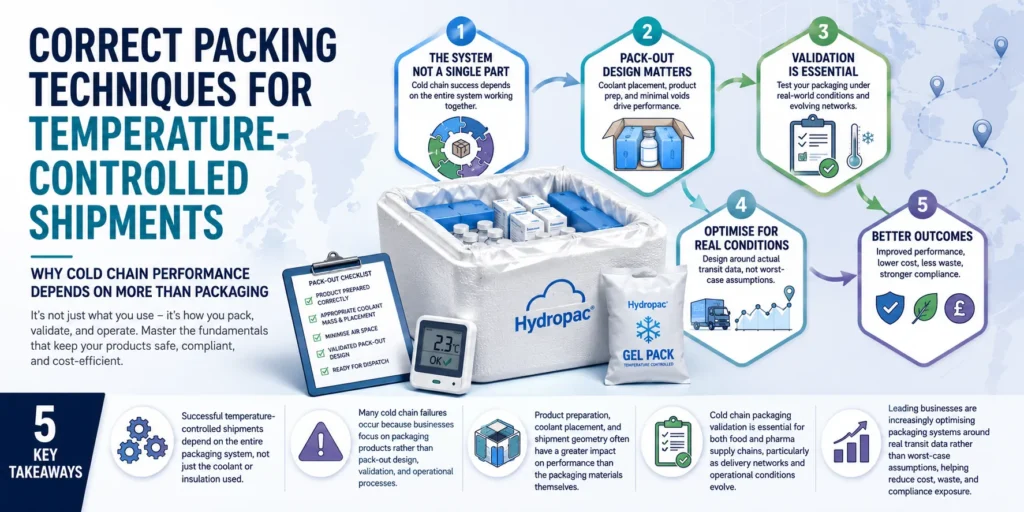
Correct Packing Techniques for Temperature-Controlled Shipments: Why Cold Chain Performance Depends on More Than Packaging
The cold chain industry has never had access to more packaging innovation than it does today. Advanced insulation materials, sophisticated phase change technologies, real-time monitoring devices, and highly engineered shipping systems have transformed what is possible in temperature-controlled logistics.
Yet despite these advances, temperature excursions remain one of the most persistent challenges facing both food and pharmaceutical supply chains.
We see industry estimates that suggest that up to 20% of temperature-sensitive pharmaceutical products are damaged during transport due to failures within the cold chain (Dickson), resulting in significant financial losses and potential risks to patient safety (Pharmaceutical Commerce). In food supply chains, temperature deviations contribute to spoilage, waste, customer complaints, and unnecessary operational costs.
The problem is that many businesses assume packaging alone guarantees performance.
What happens day to day is that temperature-controlled shipping is rarely determined by the packaging components themselves. More often, it comes down to how those components are used, how products are packed, and whether the system has been designed around real operational conditions.
At Hydropac, we regularly see businesses investing heavily in cold chain packaging while overlooking the pack-out and operational practices that have an equal, if not greater, influence on shipment performance.
Understanding the fundamentals of correct packing techniques is therefore essential, not only for protecting products but also for improving efficiency, reducing waste, and controlling costs.
Want to discuss your temperature-controlled shipments? Contact Hydropac for a cold chain consultation.
Why Temperature-Controlled Shipments Still Fail
When temperature excursions occur, businesses often look first at the packaging materials. Was the insulation thick enough? Were the coolant packs sufficient? Should a different packaging format have been selected?
While these questions are important, they rarely tell the full story.
Most cold chain failures occur because of a combination of operational and packaging-related factors.
Common causes include:
- Incorrect coolant placement
- Poor product preparation
- Excessive air space within the shipper
- Insufficient coolant mass
- Delayed dispatch
- Carrier disruptions
- Seasonal temperature variations
- Inconsistent packing procedures
In many cases, the packaging system itself is capable of maintaining temperature, but the way it has been packed or deployed compromises performance.
This distinction matters because businesses often respond to temperature issues by adding more packaging rather than addressing the root cause.
The result is frequently higher cost without improved performance.
The Science Behind Effective Cold Chain Packaging
Every temperature-controlled shipment functions as a thermal system.
The purpose of the packaging is not to actively cool products. Its role is to maintain the desired temperature range for as long as possible despite changing external conditions.
Three factors largely determine whether this happens successfully:
1. Thermal Mass
Thermal mass refers to the amount of cooling energy available within the shipment.
This is influenced by:
- Product mass
- Coolant quantity
- Coolant type
- Starting temperatures
A larger thermal mass generally provides greater temperature stability, but more is not always better.
Adding unnecessary coolant increases shipment weight, transport costs, handling complexity, and, increasingly, EPR-related costs.
The objective should always be optimisation rather than maximisation.
2. Insulation Performance
Insulation slows heat transfer between the external environment and the product.
However, insulation cannot compensate indefinitely for poor pack-out design.
Even highly effective insulation will underperform if:
- Coolant is incorrectly positioned
- Products are packed warm
- Excessive void space exists
- Transit durations exceed design assumptions
3. Air Movement Within the Package
This is one of the most overlooked aspects of cold chain packaging.
Large void spaces allow warm air to circulate within the package, creating temperature inconsistencies and increasing the workload placed on coolant systems.
Many businesses compensate by adding additional coolant when the real issue is packaging geometry.
A correctly sized shipper with appropriate product placement will often outperform a larger shipper carrying significantly more coolant.
The Most Overlooked Variable: Product Preparation
One of the simplest and most common mistakes occurs before the product even enters the packaging system.
Packaging maintains temperature. It does not create it.
If chilled products enter the pack-out process above their required temperature range, the coolant system must first work to remove that excess heat before maintaining conditions throughout transit.
This creates unnecessary strain on the packaging system and increases the likelihood of temperature excursions.
Best practice should always include:
- Verifying product temperatures before packing
- Maintaining temperature-controlled staging areas
- Minimising exposure during fulfilment
- Establishing documented handling procedures
This applies equally to cold chain packaging for meat products and pharmaceutical cold chain packaging.
The most sophisticated packaging solution cannot compensate for poor product preparation.
Why Coolant Placement Matters More Than Most People Think
Much of the industry debate focuses on coolant type.
- Gel packs versus water packs.
- Phase change materials versus ice.
- Reusable versus disposable solutions.
These discussions are valuable, but they can sometimes distract from a more important question: where is the coolant being positioned?
Cold air naturally sinks while warm air rises.
Understanding these thermal dynamics is essential when designing effective pack-outs.
For food shipments, common considerations include:
- Distributing coolant evenly
- Protecting products from direct freezing
- Managing airflow within the shipper
- Positioning coolant relative to expected heat gain
For pharmaceutical shipments, coolant placement must align precisely with validated pack-out configurations.
Even small changes to a validated pharmaceutical packaging system can affect qualification status and performance outcomes. This is why pack-out consistency is so important.
The best packaging system in the world will struggle if shipments are packed differently every day.
If your team relies on multiple fulfilment locations, seasonal staff, or third-party logistics providers, contact Hydropac for a review on how to improve your performance.
The Hidden Cost of Overpacking
One of the biggest challenges we see across both food and pharmaceutical supply chains is overpackaging.
This usually develops gradually. It might be brought on by a summer delivery issue, so an additional coolant pack is introduced. Perhaps there was a carrier that experienced a delay, and to compensate, another layer of insulation is added.
Over time, temporary precautions become permanent operating procedures.
The problem is that these decisions are rarely revisited and the commercial impact can be significant.
Overpackaging often leads to:
- Higher packaging spend
- Increased transport costs
- Greater EPR exposure
- Reduced pallet efficiency
- Longer packing times
- Increased packaging waste
Industry estimates suggest that relatively small increases in shipment weight can increase logistics costs by between 5% and 10%, particularly within last-mile delivery operations (McKinsey).
For businesses shipping thousands of temperature-controlled orders each week, these costs accumulate quickly. The goal should not be to eliminate risk.
It should be to understand risk accurately and design packaging accordingly.
Why Cold Chain Packaging Validation Matters
Cold chain packaging validation is often viewed as a pharmaceutical requirement.
In reality, it should be considered best practice across both food and pharmaceutical supply chains.
Validation answers critical questions:
- How will the packaging perform in summer?
- How will it perform in winter?
- What happens if delivery is delayed?
- How much operational variability can the system tolerate?
- What are the true performance limits?
A robust validation programme typically includes:
- Thermal mapping
- Distribution simulation testing
- Summer and winter profiles
- Packaging qualification studies
- Ongoing performance monitoring
This becomes increasingly important as supply chains evolve.
Carrier might performance change or customer expectations shift.
A packaging system validated five years ago may no longer represent the most efficient solution available today.
Food vs Pharmaceutical Cold Chain Packaging: Different Priorities, Same Principles
Although food and pharmaceutical supply chains operate differently, the fundamentals of effective packing remain remarkably similar.
Food Supply Chains
Food businesses typically focus on:
- Product quality
- Shelf life
- Customer experience
- Cost control
- Operational efficiency
Cold chain packaging for meat, seafood, meal kits, and chilled products must balance performance with commercial practicality.
Pharmaceutical Supply Chains
Pharmaceutical businesses often prioritise:
- Product stability
- Regulatory compliance
- Validation requirements
- Quality assurance
- Patient safety
The consequences of failure can be significantly greater, which is why pharmaceutical cold chain packaging often involves more extensive qualification and documentation processes.
Despite these differences, both sectors depend on the same underlying principles:
- Accurate temperature control
- Correct pack-out procedures
- Effective validation
- Continuous improvement
What Leading Cold Chain Operators Are Doing Differently
The most successful organisations are moving away from thinking about packaging components in isolation.
Instead, they are evaluating the entire cold chain system.
They are asking:
- What temperatures do our shipments actually experience?
- How long are deliveries really taking?
- Are we carrying unnecessary packaging weight?
- Where are temperature excursions occurring?
- What is the true cost of our packaging decisions?
This shift towards data-led decision-making is becoming increasingly important.
According to Grand View Research, the global cold chain logistics market is expected to continue growing significantly throughout the coming decade as demand for temperature-sensitive food, biologics, vaccines, and pharmaceutical products increases.
As supply chains become more complex, optimisation becomes increasingly valuable.
Many businesses are surprised by how much performance and cost improvement can be achieved simply by reviewing pack-out procedures, shipment data, and packaging validation rather than changing packaging materials altogether. Get in touch with Hydropac for a consult.
Your Packaging Should Evolve With Your Cold Chain
Correct packing techniques remain one of the most influential and often underestimated factors in cold chain performance.
While businesses understandably focus on insulation materials, coolant technologies, and packaging products, many temperature excursions are caused by issues that occur much earlier in the process. Product preparation, pack-out consistency, coolant placement, shipment geometry, and validation all play critical roles in determining whether a shipment succeeds or fails.
As cold chain logistics continue to grow in complexity and importance, organisations that take a system-level approach to packaging performance will be best positioned to improve reliability, reduce waste, control costs, and meet evolving customer and regulatory expectations.
Hydropac's Approach to Cold Chain Performance
At Hydropac, we believe packaging performance should be engineered, measured, and continually improved.
That means looking beyond individual products and understanding how the entire cold chain system operates.
We work with businesses to assess:
- Transit lanes
- Packaging configurations
- Coolant requirements
- Validation protocols
- Operational handling processes
- Cost drivers
- EPR exposure
The objective is not simply to recommend packaging. It is to design systems that perform reliably while remaining commercially efficient and operationally practical.
Because ultimately, successful temperature-controlled shipping is not determined by what packaging you buy but by how effectively the entire system works together.