
Cold Chain Risk Management: The Hidden Costs Most Businesses Miss
For many organisations, cold chain risk management focuses on preventing major temperature excursions. While these events are important, they are not always the greatest source of cost.
Across large distribution networks, small inefficiencies can accumulate into substantial financial leakage. Rework labour, repeat investigations, packaging adjustments and recurring seasonal issues often go untracked, quietly increasing operational spend without appearing as a formal failure.
Understanding where these hidden costs sit allows supply chain teams to move from reactive problem-solving toward targeted optimisation.
Five Key Takeaways
- Most cold chain risk costs do not appear as line items – they show as operational “noise”.
- Repeat failures, rework and over-packaging are major hidden profit drains.
- Lack of root cause analysis perpetuates recurring lane and seasonal issues.
- Simple tracking metrics reveal where cold chain risk management should focus.
- Addressing hidden leakage strengthens both commercial and operational performance.
The Costs You Don’t See
When a cold chain fails dramatically, the cost is obvious to all. Whether it’s spoiled or wasted products, increase in customer refunds and emergency reshipments or expedited freight – these are visible and measurable. They are formally acknowledged and recorded as well as being investigated in some capacity – but they are rarely the largest cumulative expense.
The larger commercial risk lies elsewhere – in the everyday inefficiencies that never make it onto a P&L line as “cold chain failure”. To put this into context, imagine just 1% of your annual temperature-controlled shipments require rework or investigation. If each shipment costs £40–£75 in labour, packaging, administration and handling time, a business shipping 50,000 consignments per year could quietly absorb £20,000–£37,500 in avoidable cost – before freight upgrades or customer impact are considered.
That level of leakage rarely appears as a single line item. But it affects margin all the same.
According to the Cold Chain Federation 2024 report, UK cold chain businesses face sustained margin pressure due to rising energy, transport and compliance costs. In this high-pressure climate, untracked inefficiencies – cannot be overlooked.
For teams looking to move from reactive fixes to structured optimisation, we also welcome site visits to our facility to review packaging design, testing and risk assessment in practice.
The Hidden Costs: Where Money Leaks
In our experience, cold chain risk management often misses the following:
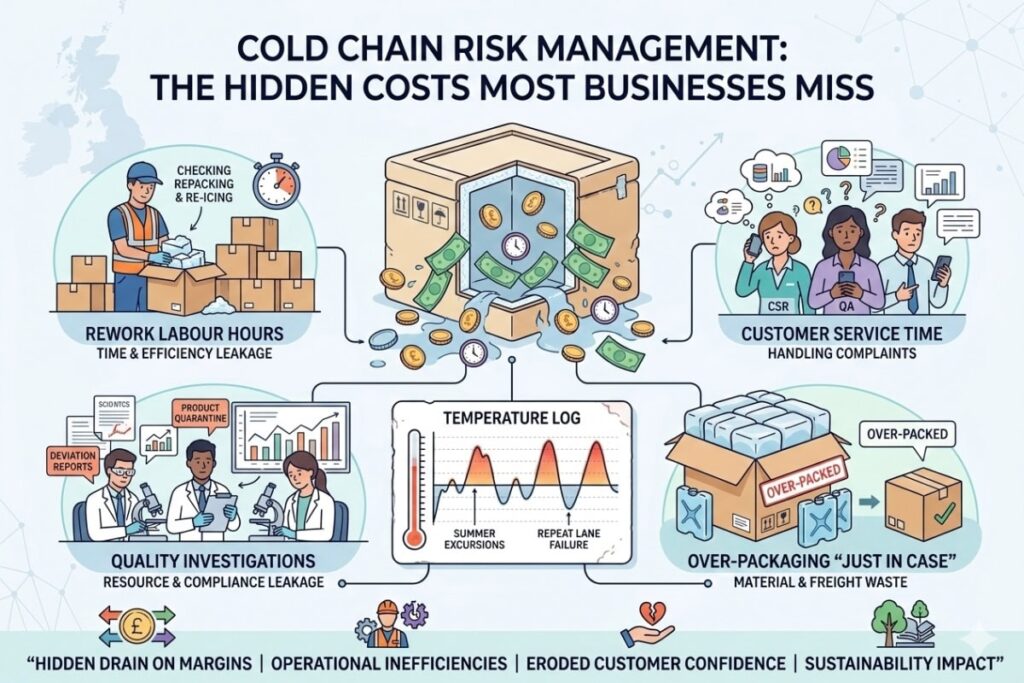
Rework labour hours: When a shipment is questioned, even if the product is ultimately usable, it often needs to be checked, repacked, re-iced or moved in and out of quarantine. That handling takes time – and time is cost. A few small rework tasks each week can quietly turn into hundreds of hours over the course of a year.
Customer service time spent handling complaints: A single temperature query rarely involves just one person. Customer service, operations, QA and commercial teams may all need to review records, check data and respond. Even when the issue is resolved quickly, internal time has been used, and that time is rarely accounted for against cold chain performance.
Quality investigations: In pharma, a temperature concern can trigger deviation reports, documentation reviews and even product quarantine. In food, it may require shelf-life checks or internal hygiene assessments. These investigations consume experienced resource and slow down normal operations, even if the product is eventually cleared.
Management review time: Minor, yet repetitive cold chain issues often escalate into monthly reviews or performance meetings. When the same routes or seasonal problems keep appearing in management discussions, it is a sign that cost is being absorbed rather than addressed. Senior time spent reviewing recurring issues is an indirect but very real commercial impact.
Packaging wasted on failed deliveries: When deliveries are rejected or returned, packaging is often damaged or discarded. Coolant may need reconditioning, cartons may not be reusable, and insulation may be scrapped. This increases material spend and affects sustainability reporting, even if overall failure rates appear low.
Emergency packaging adjustments: When confidence drops, teams often with reactive adjustments feel sensible in the moment, but they are rarely reviewed afterwards. Over time, temporary fixes become permanent cost increases.
Over-packaging “just in case”: If a route fails once, the instinct is often to increase protection across all similar shipments. Instead of targeting the specific risk, the whole system absorbs additional weight and material cost. This extra spend may not be visible in isolation, but across thousands of shipments it becomes significant.
Lost repeat business due to eroded confidence: Repeated minor temperature concerns can affect how reliable your operation is perceived to be. Even without formal complaints, confidence can weaken over time. In competitive food and pharmaceutical markets, reliability directly influences renewal decisions and future tenders.
None of these appear neatly categorised under “cold chain failure”, yet over a year, they accumulate significantly, meaning it’s important to attach approximate cost to these patterns – for example:
- Average internal cost per rework incident
- Additional freight cost per upgraded shipment
- Total hours spent on temperature-related investigations per quarter
When operational data is translated into actual financial impact, it becomes far easier to justify small, targeted improvements rather than broad cost increases, recurring operational inefficiencies – not catastrophic disruption – are one of the primary sources of cost leakage across UK supply chains.
Cold chain operations are no exception.
Suspect cost leakage? We can support a focused review to identify where it’s happening - and which changes will deliver measurable financial impact.
The “Repeat Problem” Trap
One of the most expensive patterns in cold chain management is repetition, for example –
- The same route underperforms every summer.
- The same customer reports temperature concerns.
- The same region experiences delivery delays.
Without structured root cause analysis, and in a fast-paced environment, the problem becomes normalised, teams adapt behaviour with reactive fixes that often include adding more coolant, rushing replacements and accept higher cost.
When practiced in isolation, there are often the right tactics, but without proper analysis and strategic response, the underlying design issue remains.
It’s important to note that repeat problems are rarely random – they often indicate misalignment between packaging, process and transit reality. In structured cold chain reviews, we consistently find that a small proportion of routes account for the majority of recurring temperature queries. Yet in response, businesses often increase packaging protection across the entire network, spreading cost instead of solving the issue at hand.
What to Track to Spot the Leaks
Effective cold chain risk management does not require labour intensive, complex dashboards. It starts with real understanding and requires consistency to maintain.
Tracking areas such as:
- Percentage of delayed deliveries by lane
- Frequency of temperature excursions by route
- Repeat customer complaints
- Rework labour hours per month
- Claims resolution time
- Seasonal variance patterns
Allow you to identify those patterns that reveal leverage points and where impactful changes can be made. For example:
- A small number of Tier 3 lanes may account for most issues.
- One seasonal period may drive disproportionate cost.
- One packaging configuration may underperform consistently.
But without tracking these ‘minor’ (major!) points, leakage remains undetected.
Commercial Consequences
The hidden cost of cold chain risk is not just operational. It affects:
- Procurement leverage
- Customer retention
- Sustainability metrics
- Internal resource allocation
Cold chain performance does more than just protect products – it protects negotiation position when discussing pricing or contract renewals. If left:
- High complaint frequency weakens pricing power
- Inconsistent seasonal performance increases audit scrutiny.
- Over-packaging increases reported material usage and freight spend, affecting both cost control and sustainability metrics.
- In competitive food and pharmaceutical markets, operational consistency is a commercial advantage while loss of confidence can quietly impact future revenue.
Cold chain risk management is not solely about preventing catastrophic failure, it is about identifying where cost quietly escapes.
By examining repeat issues, rework frequency and lane variability, organisations can redirect investment toward high-impact optimisation.
If you would like support identifying where cost may be leaking within your cold chain, we can assist with a structured review focused on measurable improvement.