
Rethinking Cold Chain Packaging in the EPR Era: Turning Compliance into Competitive Advantage
For years, cold chain packaging has largely been treated as a functional necessity. If products arrived within temperature range and damage rates remained low, the system was considered successful. But we have seen this approach becoming increasingly unsustainable. The introduction of Extended Producer Responsibility (EPR), rising transport costs, pressure on operational margins, and growing scrutiny around sustainability are changing how cold chains are evaluated. Cold chain optimisation is no longer about randomly adding ice packs and hoping for the best. It is now a financial, regulatory, and strategic variable. This shift is forcing businesses across food, pharmaceutical, and healthcare supply chains to ask a different question. The question is no longer, “Does our packaging work?” but instead, “Is our cold chain designed as efficiently as it could be?” For many organisations, the answer is no.
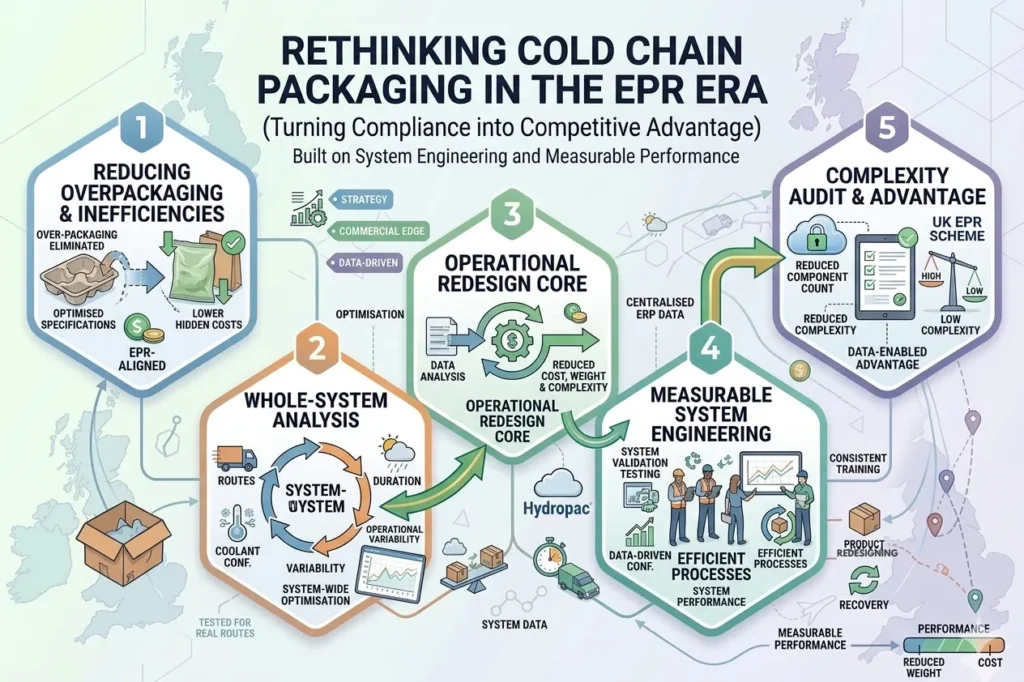
Five Key Takeaways
- EPR is forcing businesses to rethink cold chain packaging as a commercial and operational strategy, not just a compliance issue.
- Many cold chains are overpackaged, over-specified, and carrying hidden cost inefficiencies.
- True cold chain optimisation involves analysing the entire system, including routes, durations, insulation, coolant configuration, and operational variability.
- The businesses gaining advantage are using packaging data to reduce weight, cost, and complexity without compromising performance.
- Hydropac’s approach is built around system engineering and measurable performance, not simply supplying ice packs.
Rethinking Cold Chain Packaging in the EPR Era
For years, cold chain packaging has largely been treated as a functional necessity. If products arrived within temperature range and damage rates remained low, the system was considered successful.
But we have seen this approach becoming increasingly unsustainable.
The introduction of Extended Producer Responsibility (EPR), rising transport costs, pressure on operational margins, and growing scrutiny around sustainability are changing how cold chains are evaluated. Cold chain optimisation is no longer about randomly adding ice packs and hoping for the best. It is now a financial, regulatory, and strategic variable.
This shift is forcing businesses across food, pharmaceutical, and healthcare supply chains to ask a different question.
The question is no longer, “Does our packaging work?” but instead, “Is our cold chain designed as efficiently as it could be?”
For many organisations, the answer is no.
The EPR Era Is Exposing Longstanding Inefficiencies
EPR has brought to surface a conversation across temperature-controlled logistics and it can no longer be ignored. Businesses are realising that many existing packaging systems were built around assumptions that are no longer commercially viable.
Historically, over-specification was seen as acceptable. Adding additional coolant or increasing insulation thickness created a perceived safety margin. The cost impact was relatively small and rarely scrutinised in detail.
But that logic has changed.
Under EPR, businesses are now financially responsible for the packaging they place into the market. The heavier and less recyclable the packaging, the greater the associated cost exposure – this should make you think twice about whether all those fancy packaging inserts are needed.
This is particularly significant in cold chain environments, where coolant often represents the heaviest component of the shipment.
The UK Parliament’s EPR briefing, has indicated that the reforms are designed to shift the full net cost of household packaging waste onto producers, changing the economics of packaging decisions across supply chains.
At the same time, the UK generates more than 190 million tonnes of waste annually, with packaging remaining a major area of regulatory focus. As reporting obligations increase, businesses face greater pressure to understand exactly what they are shipping, how much it weighs, and whether it is necessary.
So, What Cold Chain Optimisation Actually Mean?
Cold chain optimisation is often misunderstood.
Businesses assume it refers simply to changing packaging materials or switching coolant types. In reality, true optimisation is a far broader process.
At Hydropac, optimisation begins with understanding how the entire cold chain performs in real operational conditions. That means looking beyond individual components and analysing the system as a whole.
This typically includes:
- Shipment profiles and delivery routes
- Transit duration and variability
- Seasonal temperature fluctuations
- Product sensitivity
- Packaging configuration and coolant placement
- Insulation performance
- Fulfilment processes and handling conditions
The objective is not only to reduce packaging, but to identify where packaging is over-specified, underperforming, or carrying unnecessary costs.
In many cases, we’ve seen businesses use packaging configurations designed for worst-case assumptions rather than real-world lane performance. This creates systems that are heavier, more expensive, and operationally inefficient without delivering meaningful improvements in protection.
Our new Cold Consult tool allows you to clearly highlight the vulnerabilities and opportunities in your cold chain.
The Most Common Mistakes Businesses Are Making
One of the clearest patterns emerging across the industry is that many cold chains have evolved reactively rather than strategically. Packaging decisions are often inherited, repeated, or adjusted incrementally over time without a full reassessment of the system.
Let’s look at the big issues this creates:
Overpackaging
The most common problem is excessive coolant usage. Businesses frequently add extra gel packs as a precautionary measure without validating whether they are genuinely required.
This may reduce perceived risk, but it also increases:
- Packaging weight
- EPR exposure
- Transport cost
- Handling inefficiency
In fact, the additional coolant provides little measurable performance benefit.
Using the Wrong Pack Type
Another common issue is selecting packaging based on habit rather than application.
Many continue using gel-based systems because they are seen as the “premium” option, despite equivalent performance being achievable through alternative solutions when engineered correctly.
Others choose packaging based on unit price alone, without considering the wider impact on compliance cost, transport efficiency, or operational complexity.
This creates decisions that appear cost-effective initially but become increasingly expensive over time.
Ignoring Route and Duration Variability
Many packaging systems are designed around a single assumed transit condition. Real-world cold chains are rarely that predictable.
In reality, transit times fluctuate, delivery routes change and seasonal conditions vary significantly throughout the year.
A packaging configuration that performs effectively in winter may be unnecessarily heavy during milder months. Equally, a system designed for next-day delivery may struggle during peak operational periods or carrier delays.
Without understanding these variables, businesses often compensate by overpacking year-round.
Ready to transform your cold chain from cost to performance? Learn more about which water solution is right for you.
Why System-Level Thinking Matters
One of the biggest shifts happening within the industry is the move from component-level thinking to system-level thinking.
Many are now taking a more integrated approach. They are evaluating cold chain performance based on total system impact, including:
- Cost per shipment
- Packaging weight
- EPR exposure
- Transport efficiency
- Operational handling
- Temperature performance
- Customer experience
This allows them to identify where changes in one part of the system can create improvements elsewhere.
For example, improving insulation performance may allow coolant volume to be reduced. Reducing coolant weight may lower both transport costs and EPR fees simultaneously. Standardising pack-out configurations may improve operational efficiency while also improving reporting accuracy.
This is where and how meaningful optimisation happens.
The Difference Between Suppliers and Cold Chain Partners
One of the gaps in the market is that many packaging providers still operate primarily as product suppliers. The conversation remains focused on individual components rather than broader system performance and this creates a massive disconnect.
Businesses are often sold packaging products without a detailed understanding of:
- Actual route requirements
- Temperature risk profiles
- Seasonal variation
- Operational handling realities
- EPR implications
As a result, packaging systems are frequently designed around assumptions rather than measured performance data.
At Hydropac we approach the problem differently.
Rather than starting with a product, the process starts with understanding your cold chain itself. The objective is not to sell more coolant or more packaging. It is to engineer a system that performs reliably while minimising unnecessary cost and complexity.
What an Optimisation Process Looks Like in Practice
In practical terms, our cold chain optimisation is typically a staged process.
- Audit and Assessment
The first step is understanding the current system. This includes reviewing:
- Packaging formats
- Coolant configurations
- Shipment data
- Transit lanes
- Seasonal performance
- Existing costs and reporting exposure
This stage often reveals inefficiencies that businesses were previously unaware of.
- Thermal and Operational Testing
The next stage is validating performance.
This may involve:
- Controlled thermal testing
- Lane-specific simulations
- Reviewing actual delivery performance data
- Assessing how packaging performs under variable conditions
The goal is to identify where systems are overperforming, underperforming, or carrying unnecessary material weight.
- Redesign and Simplification
Once performance requirements are clearly understood, packaging configurations can be redesigned around actual operational needs.
This may include:
- Reducing coolant volume
- Changing pack placement
- Improving insulation efficiency
- Introducing alternative cooling systems
- Simplifying pack-out processes
Importantly, optimisation is not about reducing protection. It is about removing unnecessary inefficiency.
Ready to transform your cold chain?
Speak with an optimisation expert at Hydropac.
What Optimisation Can Achieve
While every cold chain is different, the outcomes of optimisation are often broader than businesses initially expect.
In many cases, businesses achieve:
- Lower packaging weight
- Reduced EPR exposure
- Lower transport costs
- Improved fulfilment efficiency
- More consistent thermal performance
- Better visibility into packaging data and reporting
Even relatively small reductions in shipment weight can create meaningful financial impact when scaled across thousands of orders.
When Should a Business Engage with Hydropac?
One of the biggest misconceptions around optimisation is that businesses should only review their cold chain when problems emerge. This couldn’t be more wrong!
The best time to assess packaging performance is before inefficiencies become embedded at scale.
Typically, businesses benefit most from optimisation support when they are:
- Scaling D2C operations
- Entering new delivery regions
- Reviewing packaging costs
- Facing increased EPR exposure
- Experiencing operational complexity
- Launching temperature-sensitive product lines
- Reassessing sustainability targets
Cold chains are rarely static. As operations evolve, packaging systems need to evolve alongside them.
Compliance Is No Longer Separate from Commercial Performance
Perhaps the biggest change taking place is that compliance and commercial performance are no longer separate conversations.
EPR has brought these worlds together.
Packaging decisions now directly affect:
- Margin
- Operational efficiency
- Transport cost
- Sustainability reporting
- Regulatory exposure
Businesses that continue to treat compliance as a standalone obligation will struggle to optimise effectively.
Those that integrate compliance into broader cold chain strategy are far more likely to gain competitive advantage.
Where does Hydropac fit in?
At Hydropac, we view cold chain optimisation as an engineering and performance challenge rather than a packaging supply exercise.
We do not assume that more packaging equals better performance. Nor do we believe there is a universal solution for every shipment type or supply chain.
Our approach is based on measured performance data, operational realities, and system-level analysis.
That means helping businesses design cold chains that are:
- Operationally efficient
- Commercially sustainable
- EPR-aware
- Fit for real-world conditions
Because in the current environment, the businesses that succeed will not necessarily be the ones using the most packaging.
They will be the ones using the right packaging, in the right way, for the right conditions.
The businesses that approach optimisation proactively will not just reduce cost. They will build more resilient, scalable, and commercially effective supply chains for the future.