
Cold Chain Resilience: How to Protect Shipments Without Over-Engineering
Cold chains are under increasing pressure. Rising energy costs, transport disruption, labour shortages and higher customer expectations all make temperature-controlled distribution more difficult to manage.
In response, many organisations increase protection by adding more coolant, thicker insulation or larger packaging. While this feels like the safest option, it often introduces new operational and commercial challenges.
True resilience in cold chain supply chain management is not about adding more material. It is about designing systems that protect product integrity while keeping cost, complexity and waste under control.
5 Key Takeaways
- Cold chain resilience is about stability under pressure – not adding more material.
- Over-engineering often increases freight, labour and sustainability cost without improving performance.
- Blanket upgrades spread cost across the entire network instead of targeting high-risk lanes.
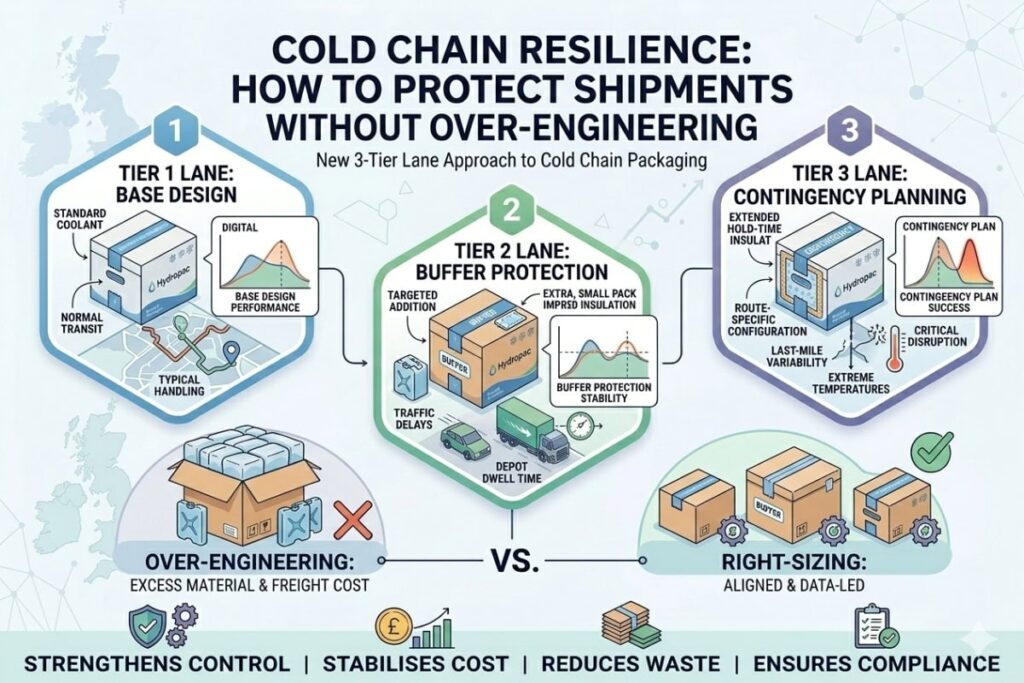
- A clear three-tier framework (Base, Buffer, Contingency) prevents reactive packaging escalation.
- Right-sized, data-led protection strengthens both operational performance and commercial control.
When cold chain disruption increases, most organisations respond in the same way – they react – by adding protection, this could look like more coolant, thicker insulation or bigger boxes.
On the surface, it feels sensible – if risk is increasing, add more protection. However, in cold chain supply chain management, that reaction often creates new problems:
- Higher freight costs
- Heavier parcels
- Increased material use
- Slower packing processes
- Sustainability setbacks
All leading to growing frustrations and departmental challenges to solve. In many of the conversations we have with operations and procurement teams, the same concern comes up:
“We’re adding cost, but we’re not sure we’re adding control.”
Resilience in cold chain management isn’t about adding layers, iIt’s about designing a system that can handle disruption without wastage.
According to the UK Cold Chain Federation’s 2024 Cold Chain Report, the UK cold chain contributes over £14 billion in gross value added to the UK economy. At the same time, businesses are dealing with rising energy prices, transport volatility and labour shortages. In this environment, resilience must make commercial sense – not just technical sense.
The real question for supply chain teams is: How do we strengthen protection without over-engineering?
If you’re unsure whether added protection is genuinely increasing control - or simply increasing cost - we can help you assess where resilience is aligned and where it may be over-engineered.
What Cold Chain Resilience Means in Real Terms
Resilience isn’t about perfection, it’s about stability. In practical terms, this means:
Shipments stay within specification even when delivery is delayed: Delays are not rare events, they are an unfortunate part of normal logistics. Traffic congestion, depot dwell time, multi-drop routes and last-mile variability all introduce unpredictability. A resilient cold chain is designed to absorb realistic delays without triggering temperature excursions or urgent intervention.
Product quality holds up during warmer weather: Seasonal temperature spikes are predictable, even if their exact intensity varies. Resilience means packaging and processes are designed with realistic summer conditions in mind, not just average annual temperatures. This protects shelf life in food supply chains and reduces excursion risk in pharmaceutical distribution.
Packing inconsistencies don’t automatically cause failure: In busy operations, packing is performed by people and minor variation is inevitable. A resilient system tolerates small differences in pack-out, staging time or handling without collapsing into failure. If one slight deviation immediately causes a temperature issue, the system may be too finely balanced.
Peak periods don’t create repeated problems: Volume pressure exposes weak points. During seasonal demand spikes or promotional campaigns, staging areas are busier, vehicles are fuller and teams are stretched. Resilience means performance remains consistent under load, rather than triggering repeat packaging upgrades, emergency freight or reactive fixes.
Resilience, then, is not about building a system that never experiences disruption, it’s about designing a cold chain that can absorb normal variability without triggering disproportionate cost.
This is where many organisations unintentionally drift into over-engineering. When pressure increases, whether from seasonal heat, a delayed route or a single failure, the instinct is to add protection because it feels safer.
But resilience is not measured by how much material is added, it is measured by how precisely protection aligns with real-world risk.
And that distinction is where cost either stabilises – or steadily increases.
The Difference Between Protection and Over-Engineering
More material does not automatically equal more safety.
Example 1: Excess Refrigerant
Adding extra ice packs can increase hold time on paper. But it also:
Increases parcel weight – even an additional 1–2kg per shipment can materially increase annual freight spend across thousands of consignments.
Pushes up transport costs – heavier parcels may shift shipments into higher tariff bands or reduce pallet efficiency.
Makes boxes harder to handle – extra weight slows packing, increases strain risk and reduces pick-line efficiency during peak periods
Increases condensation – excess coolant can create internal moisture build-up, affecting outer packaging integrity and presentation.
Risks freezing sensitive products – overcooling can be just as damaging as overheating – particularly for temperature-sensitive pharmaceuticals or chilled food products.
Across a full year of distribution, small increases in weight and material use can translate into five-figure additional cost, without necessarily improving performance.
Example 2: Oversized Packaging
Using larger cartons or higher-spec insulation can feel like a safe decision. But oversizing has commercial consequences that compound over time.
Increases volumetric freight charges – Many carriers price by volume, not just weight. A small increase in carton dimensions can shift shipments into a higher pricing bracket across thousands of consignments.
Reduces pallet efficiency – Fewer cartons per pallet increases the number of pallets required, driving higher transport and handling costs.
Wastes material – Larger boxes and additional insulation mean more corrugate, more liner and more packaging input per shipment.
Impacts sustainability reporting – Higher material usage affects packaging reporting obligations and increases Scope 3 emissions linked to transport weight and volume.
Consumes more warehouse space – oversized configurations take up more storage capacity, which becomes particularly visible during peak seasonal pressure.
When applied across a full distribution network, even modest oversizing can add tens of thousands of pounds annually in freight and material cost – without addressing the root cause of performance variability.
Example 3: Blanket Upgrades
When a failure occurs, the natural reaction is to increase protection everywhere; a summer heat spike on one route leads to a network-wide coolant increase, or one delayed depot results in upgraded packaging across all similar shipments.
This feels proactive, but it spreads cost far beyond the original risk.
High-risk design becomes the default –Configurations built for exceptional circumstances become standard practice year-round.
Cost is distributed instead of targeted – Instead of addressing a specific lane, customer or seasonal issue, the entire network absorbs additional material and freight cost.
Temporary fixes become permanent policy – Packaging changes introduced “for now” are rarely reversed once the pressure subsides.
Risk visibility decreases – If everything is upgraded, it becomes harder to identify which routes are genuinely underperforming.
In many operations, a small number of Tier 3 routes drive the majority of temperature concerns, yet protection is increased across 100% of shipments, compounding cost without improving precision.
The Right-Sizing Framework
This is where resilience becomes practical.
Rather than treating all shipments equally, we recommend thinking in three clear levels.
1. Base Design – Your Everyday Protection
This is your standard packaging configuration.
It should comfortably cover:
- Normal transit times
- Typical handling duration
- Standard ambient conditions
- Average staging time
Base design should not be fragile. It should have margin, but not excess.
For example, if your typical delivery window is 18–24 hours, your base design might protect for 30–36 hours. That gives you breathing space without unnecessary material.
Base design decisions should consider:
- Actual average transit data
- Typical loading and unloading delays
- Warehouse staging time
- Product sensitivity
Many businesses haven’t formally defined what their “base” actually is – it’s simply evolved over time.
Resilience starts by clearly defining this baseline.
2. Buffer – Realistic Delay Protection
This is where most cold chains need attention.
Buffer protection accounts for common disruption, such as:
- Traffic delays
- Missed delivery windows
- Depot dwell time
- Multi-drop exposure
- Warmer seasonal conditions
This does not mean doubling coolant across all shipments.
It may involve:
- Adding one additional coolant pack during summer months
- Adjusting pack configuration for known slower routes
- Improving insulation fit or void fill
- Tightening staging procedures
For example, if one route consistently runs 6–8 hours late during peak periods, that route may need a different configuration – not your entire operation.
This level is where most recurring failures can be prevented with small, targeted changes.
3. Contingency – High-Risk Scenarios
Contingency protection is reserved for:
- Long-distance or overnight multi-stage routes
- High-value pharmaceutical shipments
- Remote or last-mile unpredictable locations
- Extreme seasonal temperatures
- Known high-variability customers
This may include:
- Extended hold-time packaging
- Additional data logging
- Route-specific configuration
- Seasonal contingency builds
The key is discipline.
Contingency should be deliberate – not default. When contingency becomes standard practice across all shipments, cost rises quickly without proportional benefit.
Build Resilience Where It Matters Most
Not every lane carries equal risk.
The Chartered Institute of Logistics and Transport (CILT) highlighted in 2025 that last-mile variability and regional congestion remain major disruption drivers in UK distribution networks.
Instead of upgrading everything, identify:
- Routes with repeat delays
- Customers with long unloading times
- Regions with higher ambient exposure
- Seasonal spikes in complaint rates
Targeting resilience where data shows repeated strain produces stronger returns than blanket protection.
What Resilience Looks Like in Food vs Pharma
The principles are shared, but the impact differs.
Food Supply Chains
Risk often shows up as:
- Reduced shelf life
- Texture or quality change
- Spoilage
- Hygiene concerns
In food, resilience protects margin and reputation.
Pharmaceutical Supply Chains
Risk includes:
- Temperature excursions
- Audit findings
- Quarantine of stock
- Regulatory exposure
The MHRA continues to emphasise temperature control and documented distribution integrity during GDP inspections.
In pharma, resilience supports both product protection and compliance defensibility.
Many organisations discover their highest protection levels are applied to their lowest-risk routes. If you’d value a structured review of how your lanes are tiered - or would prefer to see how we assess right-sizing and packaging performance in practice - we welcome operations and procurement teams to visit our facility.
Lane Tiering Framework
| Tier | Risk Profile | Characteristics | Protection Level |
|---|---|---|---|
| Tier 1 | Stable | Predictable transit, low variability | Base design |
| Tier 2 | Moderate | Occasional delay, seasonal exposure | Buffer |
| Tier 3 | High | Last-mile, long haul, repeat variability | Contingency |
This simple approach prevents over-application of high-cost solutions.
Cold chain resilience is not about spending more.
It is about understanding where risk actually sits, and responding proportionately. In a market facing rising freight costs, sustainability pressure and regulatory scrutiny, over-engineering is no longer the safe option.
Right-sized, data-led cold chain supply chain management protects product integrity while controlling cost and waste.
If you would like to review whether your packaging and processes are proportionate to real-world conditions, we’re happy to support a structured assessment.