
The 5 Most Common Cold Chain Failure Points (and How to Prevent Them)
Cold chain logistics involve multiple stages, each presenting potential points of failure. From storage and packing to transport and final delivery, even small disruptions can affect temperature stability and product quality.
In many cases, these failures are not random. They tend to occur in predictable areas such as packaging mismatches, monitoring gaps, transit delays or handling inconsistencies.
By understanding the most common cold chain failure points, organisations can take practical steps to prevent disruption, strengthen reliability and safeguard temperature-sensitive products throughout the supply chain.
Five Key Takeaways
Most cold chain failures are predictable once patterns are understood: Issues such as packaging mismatch, monitoring gaps and transit delays tend to repeat on the same routes or under the same conditions.
Packaging must be designed for real-world conditions, not ideal transit times.: Delays, handling exposure and last-mile variability should be accounted for when validating packaging performance.
Periodic temperature checks rarely tell the full story: Without continuous monitoring and joined-up data, short temperature excursions can go unnoticed.
Human processes are as important as packaging performance: Handling procedures, staging practices and staff training all play a critical role in maintaining temperature stability.
Traceability is essential for both prevention and accountability: When data is centralised and accessible, teams can identify recurring problems and prevent the same issues from happening again.
Cold chains are complex. From storage to last mile delivery, there are multiple touchpoints where things can go wrong, and when they do – the result can be spoiled product, dissatisfied customers and unexpected costs.
Understanding where cold chains most often fail is the first step to making them more reliable and resilient. In this blog, we have identified the most commons areas of failure in the cold chain, and how to avoid them.
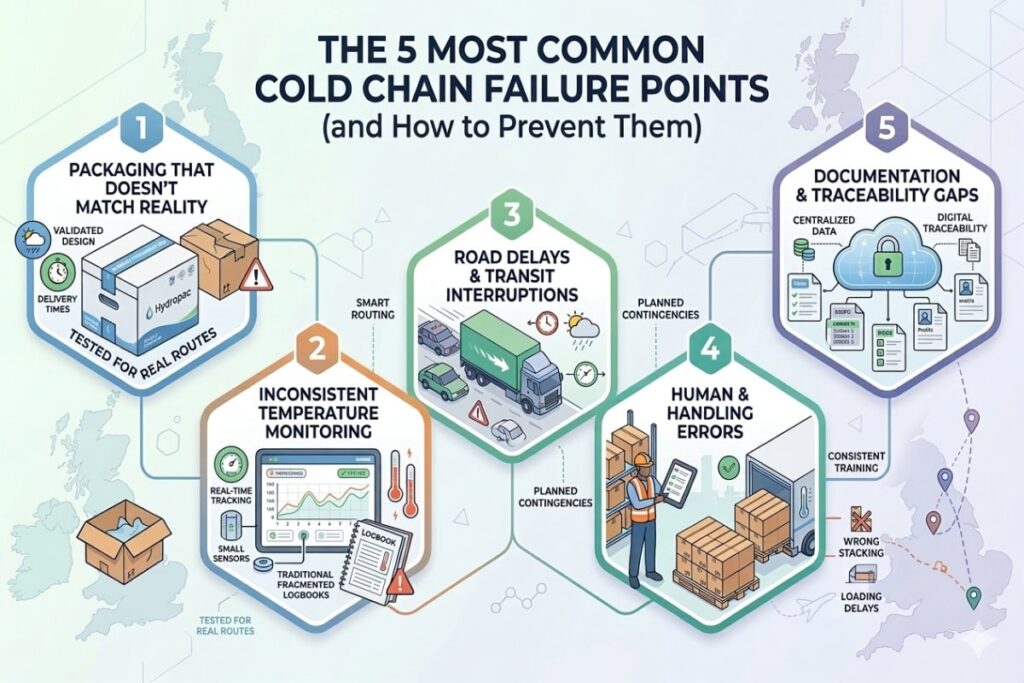
1. Packaging That Doesn’t Match Reality
Often, teams use packaging designed for a standard transit time or temperature, but not for real variations, like those day-to-day delays, heat exposure during handling, or last-mile unpredictability – the last one in particular being outside of your control.
Avoid this by:
- choosing packaging with performance tested for real-world routes
- validating with temperature logging
- understanding transit variability
This failure point is frequently cited as a core risk in cold chain logistics. Packaging not suited to actual journeys can compromise product integrity before it even reaches the customer.
2. Inconsistent Temperature Monitoring
Temperature is essential, but a failure arises when teams only check temperature periodically or rely on siloed measurement systems that mean the data exists but because its split across departments – nobody has the full picture.
For example – warehouse team records temps on paper, while the transport team has separate carrier logs and QA has excursion records – but procurement doesn’t get to see the failure trends and no one links packaging supplier data to delivery outcomes.
On paper, periodic checks sound sensible – “we checked at dispatch and again at delivery”.
But in practice, temperature issues don’t always show up at those exact moments – you can pass a temperature check and still have had a damaging heat excursion in-between. For example, a chilled product leaves at the right temperature, but it sits on a loading bay for 45 minutes, or the vehicle door is opened repeatedly on a multi-drop route. Even if the product returns to an “acceptable” temperature by the next check, the damage may already be done (reduced shelf life, quality changes, compliance risk).
Periodic checks usually happen at dispatch, delivery and depot scanning points – but risks can occur in loading, last mile, staging or re-deliveries.
Why this matters
- temperature deviations can go unnoticed
- manual checks miss short excursions
- lack of visibility means slow response
Prevention tips:
- adopt real-time temperature monitoring across shipments
- integrate monitoring with alerts
- review data trends, not just snapshots
Noticing the same issues resurface each season or on specific routes? It may be a sign the underlying design needs reviewing - we can support a focused assessment to identify where small, targeted changes will have the greatest impact.
3. Road Delays and Transit Interruptions
Delays in transit are common – whether due to traffic, weather, or carrier scheduling. Even temperature-controlled transport can be compromised if cargo sits in warm staging or transit for longer than planned.
What to plan for:
- buffer time in packaging design
- contingency SOPs for delays
- more robust insulation regimes
Many guides on cold chain risk highlight delays as a common failure, reinforcing the need for contingency planning and monitoring.
4. Human and Handling Errors
Manual errors happen- from incorrect loading procedures to forgetting to stage coolants like an ice packs- are surprisingly common but can have negative impacts. But they should be taken seriously – coolants that aren’t staged properly can result in packs that are too warm, or too cold – and can damage products inside.
Incorrect loading procedures like wrong stacking can seriously affect temperature stability – even in a temperature-controlled vehicle – more training is often needed here.
Examples:
- wrong stacking that blocks airflow
- delays during loading that warm product
- inconsistent SOP application
How to avoid these:
- consistent SOPs
- simple checklists at each step
- regular training for staff
Human error features in literature on cold chain risk and is closely tied to training and procedural clarity with real operational impact.
5. Documentation and Traceability Gaps
If you cannot track what has happened – when, where and how – then learning from failure becomes very difficult. Traceability simply means being able to track a shipment’s cold chain journey from dispatch to delivery, including who handled it and under what conditions. Without it, you can’t prove what happened, where it happened or why. This often makes it difficult to brands to protect customer relationships. Defend your process if challenged and prevent the same issues from reoccurring.
This is particularly important in pharma, where evidence and control are essential – but it also matters hugely in food, where quality concerns and customer confidence can be damaged quickly.
Identifying gaps in documentation and traceability means you can move from ‘we sent it’ to, product batch, packaging configuration, when it was packed, how long it was staged and even what the temperature profile looked like – demonstrating integrity and responsibility.
Risks include:
- lost temperature logs
- mismatched records
- disjointed systems
Prevention:
- one central data capture standard
- clear version control on records
- digital tools for visibility
Many cold chain failures are predictable once patterns are understood. If you’d like to review where risk may be concentrated in your network - and how to prevent repeat disruption - we’d welcome the conversation.
Summary – Prevention Checklist
| Failure point | Prevention tip |
|---|---|
| Packaging mismatch | Validate packaging on real routes |
| Inconsistent monitoring | Use real-time temperature tracking |
| Transit delays | Build contingency into packaging |
| Handling errors | Train and use SOP checklists |
| Documentation gaps | Centralise logs and traceability |
Identifying where cold chains commonly fail – and then building simple, practical measures to prevent these failures – is one of the fastest ways to improve reliability, reduce waste and protect value – both in the short and long term.
If you’d like tailored insight into where your cold chain might be at risk, Hydropac can help review and strengthen your operations.