
Hidden Cost of Gel Packs: How EPR Is Reshaping Cold Chain Economics
For years, cold chain packaging decisions have followed a relatively simple model. The focus has been on performance, reliability, and unit cost. If a solution kept products within temperature range and met budget expectations, it was considered effective.
That model is no longer sufficient.
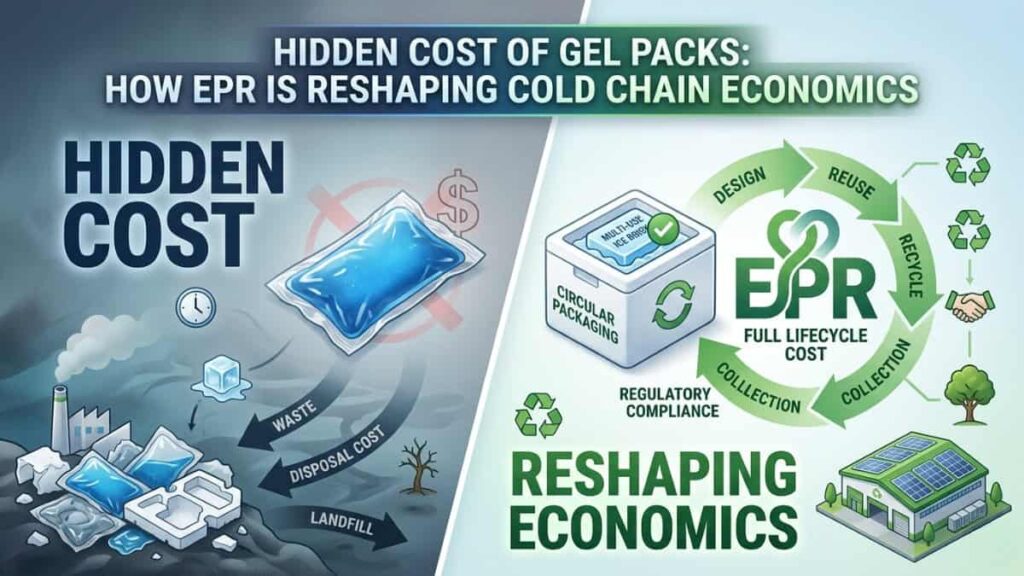
With the introduction of Extended Producer Responsibility in the UK, the economics of temperature-controlled packaging have shifted. The cost of your cold chain is no longer defined only by what you purchase. It is now shaped by what you use, what you distribute, and what you are responsible for after delivery.
This change is subtle in theory but significant in practice. Many businesses are still evaluating packaging through an outdated lens. As a result, they are missing where cost is now being driven.
Five Key Takeaways
- Cold chain costs are no longer unit-driven. They are increasingly driven by material weight under EPR.
- Gel packs are disproportionately expensive due to their high mass and limited recyclability.
- Household EPR fees are significantly increasing costs for D2C and food delivery businesses.
- Many businesses are still evaluating packaging based on unit price rather than total cost.
- Cold chain economics now need to be assessed at a system level, not just by component.
The Shift from Unit Cost to Weight-Based Cost
One of the most important changes under EPR is how cost is calculated. Historically, procurement decisions have centred on unit price. Businesses compared the cost of gel packs, insulated boxes, and liners on a per-unit basis and selected the most competitive option.
EPR introduces a different perspective. Cost is increasingly linked to the total weight of packaging placed on the market. This includes every component used to protect and transport temperature-sensitive goods.
At first glance, this may appear to be a minor adjustment. In reality, it changes how cold chain systems need to be evaluated. Packaging components are not equal in weight, and therefore they are not equal in cost exposure.
For example, two gel packs may appear similar when viewed purely on unit price. One may cost less but weigh significantly more. Under EPR, that additional weight is not neutral. It creates a compounding cost across every shipment.
This is where traditional procurement logic begins to break down.
Why Gel Packs Are Disproportionately Impacted
In most cold chain configurations, gel packs represent the largest share of total packaging weight. They are often treated as a standard, almost invisible component within the system. Their role is assumed rather than challenged.
Under EPR, this assumption becomes costly.
A typical gel pack contains a small amount of plastic film and a much larger volume of gel. The outer layer may weigh only around 13 grams, while the internal contents can weigh 500 grams or more. This means that the overwhelming majority of the reportable weight sits within the gel itself.
When EPR fees are applied, the imbalance becomes clear. The plastic film may contribute approximately 0.55 pence per unit, while the gel contents contribute around 13.75 pence. This results in a total EPR cost of roughly 14.3 pence per gel pack, with over 95 percent of that cost coming from the gel rather than the plastic
This creates a structural issue. Businesses may invest time in reducing cardboard usage or improving outer packaging efficiency, yet the heaviest component remains unchanged. As a result, the largest cost driver continues to sit within the system, often unnoticed.
The Impact of Single-Use Materials
Gel packs also present a challenge in terms of lifecycle. In many cases, they are used once and then discarded. Their material composition makes them difficult to recycle, and they are often classified under less favourable categories for reporting purposes.
EPR is designed to account for these factors. Materials that are heavier, less recyclable, and more difficult to process at end of life will carry a higher financial burden. Gel packs align with all three of these characteristics.
This is not a marginal issue. It is a structural one.
The Role of Household EPR Fees
For businesses delivering directly to consumers, there is an additional layer of cost that is often underestimated. Packaging that enters the household waste stream attracts higher fees than packaging handled within commercial systems.
This is particularly relevant for food delivery, meal kits, and direct-to-patient pharmaceutical shipments. In these cases, the majority of packaging is disposed of at home. Gel packs are rarely separated or recycled. They are treated as general waste.
This creates a compounding effect. High weight, combined with limited recyclability and household classification, leads to a significant increase in cost per shipment.
To put this into context, a business shipping 80,000 orders per month using two 500 gram gel packs per order is placing approximately 80 tonnes of gel into the market each month. Even small increases in cost per kilogram translate into tens of thousands of pounds annually once household EPR fees are applied.
At this scale, cost is no longer incremental. It becomes structural.
Want to understand the true cost of your cold chain? We help businesses evaluate packaging systems beyond unit price, try our Cold Consult tool.
What This Means at Scale
The UK’s EPR scheme is expected to cost businesses over £1.1 billion annually. At an individual level, the cost difference per unit may appear manageable. At scale, it becomes a material financial consideration.
Using the earlier example of approximately 14.3 pence per gel pack, a business shipping 100,000 orders per month with two gel packs per order would incur EPR costs of over £28,000 per month on coolant alone. That equates to more than £340,000 annually, before considering outer packaging or additional materials
What was once a relatively low-cost component becomes one of the most significant contributors to packaging-related spend.
What makes this more challenging is that these costs are not always visible in traditional procurement or operational reporting. They sit outside the metrics that many teams are used to tracking.
As a result, they are often absorbed rather than addressed.
The Core Issue: Measuring the Wrong Cost
Despite these changes, many organisations continue to evaluate packaging based on unit price alone. This approach no longer reflects the true cost of operating a cold chain.
A lower-cost gel pack may appear attractive at the point of purchase. However, if it is heavier or less recyclable, it may result in higher overall costs once EPR obligations are included.
Consider two packaging systems delivering the same thermal performance. One has a lower unit cost but uses heavier gel packs. The other has a slightly higher unit cost but reduces overall material weight. Under EPR, the second system often delivers a lower total cost per shipment, despite appearing more expensive at the point of purchase.
This is where the disconnect occurs. Businesses optimise for what is visible, rather than what is material.
Moving Towards Total Cost Understanding
Cold chain economics now need to be assessed across multiple dimensions. Unit cost remains important, but it is only one part of the picture.
Businesses must also consider packaging weight, material classification, and the associated EPR fees. These factors combine to form what can be described as the total landed and compliance cost of a packaging system.
This is the metric that ultimately determines financial performance.
Without this perspective, decisions that appear cost-effective in the short term may prove more expensive over time.
Why This Shift Has Been Overlooked
There are several reasons why this change has not yet been fully reflected in decision-making.
First, procurement processes are often built around historical models. Packaging is treated as a commodity purchase rather than a strategic variable.
Second, many organisations lack accurate data on packaging weight and composition. Without reliable information, it is difficult to assess true cost exposure.
Third, responsibility for packaging and compliance is often split across different teams. Procurement, operations, and finance may each hold part of the picture, but few organisations are bringing these perspectives together.
This creates a gap between what is happening operationally and what is being reported financially.
If you’re reviewing your cold chain strategy due to EPR changes, now is the time to challenge existing pack-outs, coolant choices, and material usage. Small packaging decisions can create significant cost differences at scale.
What Leading Businesses Are Doing Differently
Some organisations are already adapting to this new environment. They are approaching cold chain design with a broader, more integrated perspective.
Rather than focusing on individual components, they are analysing cost at the level of the shipment. This allows them to identify where packaging is over-specified or where material usage can be reduced without increasing risk.
They are also challenging assumptions around coolant. Instead of accepting existing pack-out configurations, they are testing whether the same performance can be achieved with less material or through alternative approaches.
In addition, they are exploring different cooling systems where appropriate. This may include water-based solutions or phase change materials, depending on the specific requirements of the product and delivery route.
Most importantly, they are aligning teams around a shared understanding of cost. Decisions are no longer made in isolation. Procurement, operations, and finance are working together to evaluate the full impact of packaging choices.
The Strategic Implication
EPR has not introduced entirely new costs. It has made existing inefficiencies more visible and more measurable.
Gel packs are a clear example of this. Their weight, combined with their lifecycle characteristics, means they sit at the centre of this shift in cost dynamics.
Understanding this is critical. The cost of a cold chain is not determined by individual components alone. It is defined by how those components interact within the system.
Where Hydropac Adds Value
At Hydropac, this is where we focus our work. We look beyond individual products to understand how cold chain systems perform in practice.
We support businesses in identifying where cost is being driven, how EPR impacts their operations, and where opportunities for optimisation exist. This includes evaluating packaging configurations, comparing alternative cooling strategies, and aligning performance with cost efficiency.
The objective is not simply to reduce cost. It is to build cold chains that are both compliant and commercially sustainable.
Final Thought
EPR has not made cold chains more complex. It has made the true cost of packaging more visible.
For businesses that continue to focus only on unit price, these costs will continue to rise without clear explanation.
For those willing to reassess how their cold chain is designed and measured, there is a clear opportunity to improve both efficiency and performance.
The shift is already underway. The question is whether your approach to cold chain economics is keeping pace.