
Gel vs Water Ice Packs: Performance, Cost and Compliance Compared
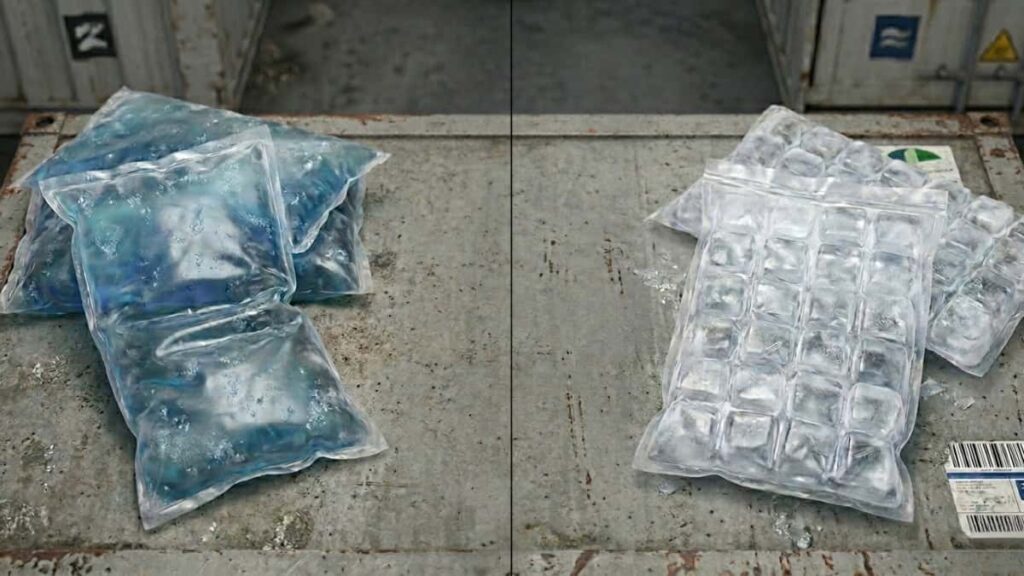
For many years, gel packs have been treated as the default choice in temperature-controlled packaging. They are widely used, broadly accepted, and often assumed to offer superior performance.
Water-based ice packs, by contrast, are sometimes seen as a lower-grade alternative. Suitable for simpler applications, but not for high-value or sensitive shipments.
This perception is deeply embedded across the industry.
It is also increasingly out of date.
As cold chain systems come under greater scrutiny, both from a performance and compliance perspective, the distinction between gel and water is being re-evaluated. What matters is no longer the material alone, but how the entire system is designed and deployed.
Five Key Takeaways
- There is no consistent or material performance advantage between gel and water packs when systems are correctly designed.
- Temperature control is driven by system design, not coolant type.
- The perception that gel is more reliable is not supported by real-world testing.
- Under EPR, gel packs are significantly more expensive due to weight and classification.
- Most gel usage today is driven by legacy thinking rather than performance data.
What Actually Drives Cold Chain Performance
Industry data consistently shows that up to 20% of temperature-sensitive pharmaceutical products are damaged during transport due to failures in cold chain execution. These failures are rarely caused by the coolant type alone. They are typically the result of poor system design, inadequate insulation, or incorrect pack configuration.
One of the most important principles in temperature-controlled logistics is often overlooked.
Performance is not determined by whether a pack contains gel or water.
It is determined by how the system is engineered.
Across repeated internal and customer-specific trials, Hydropac has not observed any consistent or material performance advantage between gel and water packs when used within a correctly designed cold chain solution.
Instead, temperature control is driven by three core factors:
- Total coolant mass
- Pack configuration and placement within the shipment
- The performance of the insulation system
These variables define how long a shipment remains within its required temperature range. The filling type of the pack plays a far smaller role than many assume.
The Reality of Consistency and Reliability
One of the most common beliefs in the market is that gel packs are more reliable or more stable than water-based alternatives.
This assumption is often repeated, particularly in higher-risk applications such as pharmaceuticals or long-duration shipments.
However, this perception is not supported by the data.
In controlled testing and real-world applications, water-based systems perform with the same level of consistency as gel packs when they are properly designed and configured. Temperature profiles remain stable, and performance is predictable across repeated shipments.
What appears to be a difference in reliability is often a difference in system design. When water-based solutions are underperforming, it is usually due to incorrect pack-out, insufficient coolant mass, or poor insulation, rather than the material itself.
Still specifying gel as the default? Let’s reassess whether your coolant strategy is based on measured performance data - or legacy assumptions.
Use-Case Assumptions vs Real-World Performance
There is a widely held view that gel is inherently better suited to certain applications, particularly:
- Pharmaceutical shipments
- Longer transit times
- Higher-value or more sensitive products
In many cases, these assumptions are driven by specification requirements rather than measured performance outcomes.
In practice, water-based systems can deliver equivalent performance across these applications when they are engineered correctly. This includes maintaining temperature ranges over extended transit periods and performing reliably across variable conditions.
The key variable is not the coolant type, but whether the system has been designed based on real lane data, environmental conditions, and product requirements.
Without that level of design, neither gel nor water will perform optimally.
The Cost Comparison: Before and After EPR
Historically, the cost difference between gel and water packs has been relatively small. In many cases, the decision between the two has not been driven by cost at all, but by habit or specification.
EPR changes that dynamic significantly.
As discussed in previous articles, packaging costs are now heavily influenced by weight and material classification. Gel packs, due to their high mass and composition, carry a greater cost burden under this model.
A typical gel pack generates an EPR cost of approximately 14.3 pence per unit, with the vast majority of that cost coming from the gel contents rather than the outer film. This doesnt sound like much per unit, but at scale the picture changes:
100,000 shipments → £14,000
1 million shipments → £140,000
Water-based systems, by contrast, avoid much of this cost exposure due to their simpler composition and different classification.
This creates a clear divergence. What was once a marginal cost difference is now a material one.
As EPR reshapes packaging economics, coolant choice is no longer just a performance decision - it’s a cost, compliance, and operational efficiency decision too. Speak to our team to learn more about our pure water solutions.
Transport and Operational Impact
The impact of gel packs extends beyond EPR fees. Their weight also affects the broader economics of the cold chain.
Heavier shipments result in:
- Increased transport costs
- Reduced pallet efficiency
- Greater handling requirements within fulfilment operations
These factors are often considered in isolation, but under EPR they become interconnected. Increased weight affects both direct logistics costs and compliance-related costs simultaneously.
When evaluated at scale, this can significantly affect overall cost per shipment.
Why Do Businesses Still Choose Gel?
Given these factors, it is reasonable to ask why gel packs remain so widely used.
The answer is not performance alone. It is a combination of legacy thinking and operational inertia.
Many organisations continue to follow existing specifications that were defined before EPR was introduced. These specifications often default to gel without re-evaluating whether it is still the most appropriate choice.
There is also a perception of reduced risk. Gel is seen as the safer option, even when data does not support a measurable advantage.
In addition, many businesses do not yet have a system-level understanding of their cold chain. Decisions are made at a component level rather than based on overall performance and cost.
This creates a situation where packaging choices are repeated, rather than reassessed.
Hydropac’s Position
At Hydropac, we do not view gel as a higher-performance solution by default.
We design cold chain systems based on measured requirements. This includes analysing transit lanes, temperature profiles, product sensitivity, and operational constraints.
From this perspective, the choice of coolant becomes one variable within a broader system. It is not the defining factor.
In many cases, we find that gel has been over-specified. It delivers the required performance, but at a higher cost than necessary, particularly under EPR.
By reassessing the system as a whole, it is often possible to achieve the same performance outcomes with a more efficient configuration.
The Core Principle
The most important takeaway is simple.
In a well-designed cold chain system, performance is engineered. It is not determined by whether the pack contains gel or water.
Focusing on the filling type alone risks overlooking the factors that actually drive results.
As EPR continues to reshape cost structures, this distinction becomes increasingly important.
Final Thought
The question is no longer whether gel or water is better in isolation.
The question is whether your cold chain has been designed based on real performance data and current cost realities.
For businesses that continue to rely on legacy assumptions, gel may remain the default choice.
For those willing to reassess their systems, there is an opportunity to achieve the same level of performance with a more efficient, compliant, and cost-effective approach.
The difference lies in how the system is understood, measured, and optimised.