
Cold Chain Optimisation: What It Really Means (Beyond Temperature)
When many people hear ‘cold chain optimisation’, they think only about temperature, keeping goods cold from A to B.
But anyone working in the food or pharmaceutical cold chain knows it’s much broader than that.
Yes, temperature matters – but it’s only one part of a wider system that, if not carefully managed, can still leak value, increase risk and undermine product quality.
In this article we’ll explain what cold chain optimisation really means, why it matters for your business, and help you recognise where improvements can make a real difference, without becoming overly technical.
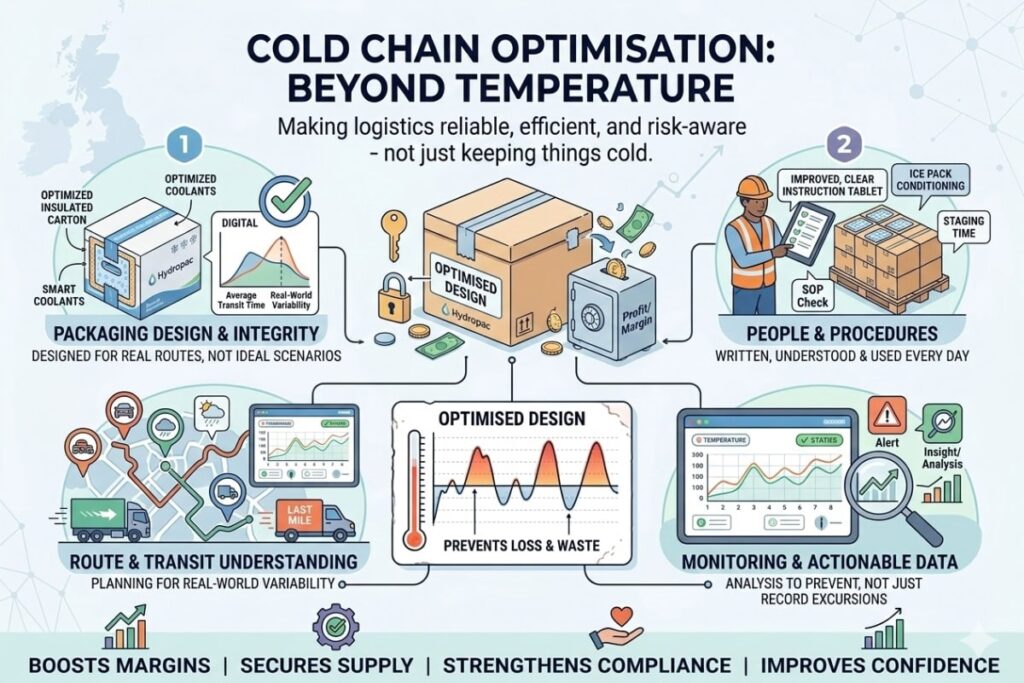
What is Cold Chain Optimisation?
In simple terms, cold chain optimisation is:
The practice of making the entire temperature-controlled logistics process more reliable, efficient and risk-aware – not just keeping things cold.
It’s about ensuring the right thing happens reliably, every time.
A well-managed cold chain:
- protects product quality from manufacture to delivery
- reduces waste and repeat cost
- improves customer confidence
- supports compliance with health, safety and regulatory expectations
And in the UK alone, the cold chain is recognised as a critical piece of infrastructure underpinning food safety, pharmaceuticals and wider economic activity – including billions of pounds’ worth of trade and hundreds of thousands of jobs.
Temperature Control is Just One Piece of the Puzzle
Maintaining temperature is fundamental – but not all failures come from the fridge (or freezer!).
Cold chain optimisation covers:
Packaging Performance
How goods are packed together with coolants and insulation – if the wrong materials or techniques are used, temperature excursions may occur even when the refrigeration is perfect.
Handling & Hygiene
Movement in warehouses, at staging points, during loading and unloading can introduce risk, for example, contamination, heat exposure and unplanned delays.
Transit & Delays
Routes change, carriers hold shipments longer than planned and last-mile unpredictability can dramatically impact product quality if not accounted for.
Monitoring & Response
Data is useful only if it triggers action; seeing a temperature spike after the fact is less helpful than having procedures in place before one happens.
People & Procedures
Even the best technology fails without clear instructions, training and consistent processes.
Optimisation means thinking systemically, not just technically.
Cold chain optimisation isn’t about adding more packaging - it’s about understanding how your system performs in real-world conditions. If you’d value a structured sense-check across packaging, handling and transit variability, we’d be happy to support it.
Why “Beyond Temperature” Matters in Practice
You might be thinking, “We control temperature, isn’t that enough?”
In theory, yes – but in practice, the cold chain is a series of interactions and potential weak spots, and optimising temperature alone can miss these.
For example:
- A delivery held in a hot depot overnight may never breach temperature – but it could shorten shelf life.
- Packaging that performs well in short hauls may fail on longer or variable routes.
- A carrier might meet temperature targets but mishandle pallets or pallets that harbour moisture or contamination.
- Data loggers might show compliance – but not tell you why an excursion happened.
Understanding these “hidden” elements is what separates coping from optimising.
What Cold Chain Optimisation Looks Like in a Real Operation
Below are the main areas teams should consider – explained simply.
1. Packaging Design and Integrity
Packaging must be designed for real-world conditions, not just ideal scenarios.
Good packaging:
- maintains temperature even with delays
- protects against physical shocks
- aligns with your actual transit patterns (not average times)
- supports handling without risk of damage or contamination
This is often where optimisation earns its keep – because better packaging doesn’t just keep things cold, it prevents loss and waste.
2. Process and Procedures
Do your teams follow a consistent process?
Examples where good procedures matter:
- Ice pack conditioning: what temperature and time before packing?
- Packing sequence: order of items, insulation layers and void fill
- Staging times: how long goods can wait before collection
Without standard procedures, performance becomes inconsistent – and you can’t improve what isn’t repeatable.
A simple self-check you can do today is to ask:
If a colleague had to pack this tomorrow without instructions, would they get the same result?
3. Handling and Human Factors
Cold chains are human systems as well as technical ones.
Common handling risks include:
- unprotected pallets introducing contamination
- loading/unloading delays in non-temperature areas
- incorrect handling procedures during shifts
Small lapses at these points can undo all the good work in temperature control and packaging.
4. Monitoring and Actionable Data
Temperature data is only valuable if it leads to action.
Optimisation means:
- Insightful alerts, not just data logs
- Analysis, not just collection
- Use of trend data to prevent future excursions
Monitoring isn’t just about proof of compliance – it’s about continuous improvement.
5. Route and Transit Understanding
Many teams manage transport as though every trip is the same.
But in reality:
- transit times vary
- carriers change routes
- weather impacts hold times
- last-mile delivery points are unpredictable
Optimisation means planning for real-world variability, not just average conditions — protecting quality even when plans slip.
If your cold chain feels robust until peak season hits, it may be time to review how it’s configured. Visit our facility to see how we evaluate risk and right-size protection without adding cost or complexity.
A Simple Checklist to Get Started
- Try answering these questions for your operation:
- Do you review packaging against actual transit data?
- Are SOPs written, understood and used every day?
- Do you account for handling and staging times outside temperature control?
- Is your monitoring data used to prevent, not just record, excursions?
- Do you consider variability in routes when designing pack-outs?
If you hesitated more than once – that’s a sign cold chain optimisation can add real value.

Why This Matters for Food and Pharma
In the UK, the cold chain supports:
- billions in food production and exports
- billions of pounds of temperature-sensitive pharmaceuticals
- jobs and economic growth across storage, transport and retail sectors
For food teams, optimisation reduces waste, preserves quality, and protects reputation.
For pharma teams, optimisation contributes to compliance, evidence of control, consistency of delivery and confidence in product efficacy.
Cold chain optimisation isn’t about adding complexity – it’s about understanding where things really go wrong and building simple, consistent, risk-reducing solutions.
The easiest starting point is always:
Look at what’s most likely to go wrong, and fix that first.
If you’d like help identifying where your cold chain can be improved – without unnecessary cost or complexity – Hydropac is here to help.
Helpful Sources & Further Reading
Here are some useful UK and industry resources for guidance and data when optimising your cold chain:
- Cold Chain Report 2024: A comprehensive UK industry overview highlighting the role of cold chains in food and pharma logistics.
- Cold chain optimisation : Trends in logistics explain why designing for real conditions matters.
- Why Temperature-Controlled Storage is Becoming a Strategic Advantage : UK perspective on pharma cold chain growth and importance.